Robert T. Rhode

Robert T. Rhode
Robert T. Rhode
Showing posts with label 1950 Chevrolet. Show all posts

Saturday, March 31, 2018

11. The Diastema ... THE FARM IN PINE VILLAGE


The 1950 Chevrolet was black. In front of the regular windows on the driver’s side and passenger’s side were triangular windows (wing vents) that could be turned in such a way as to force a blast of wind against the face. The breeze felt so good on a hot day! The windshield was in two halves joined by a thin metal connector moulding. When Robert was sitting in front (which was most of the time because he suffered from motion sickness when seated in the back), his eyes would focus first on the metal moulding then on the distant view then on the connector again, until he was well on his way toward nausea!

Joe and Ida drove differently. Joe was far-sighted and enjoyed perusing fellow farmers’ fields to his left. While doing so, he slowly veered the car to the right until the right wheels were off the road and onto the berm. Miraculously, he never lost control of the vehicle but gradually brought it back onto the pavement, only to repeat the experiment immediately afterward. Ida, meanwhile, played with the throttle. Her small foot, usually wearing a sandal in summer, wore out the gas pedal by depressing it and lifting up right away, depressing it and lifting up right away. The car lurched forward and hesitated, lurched forward and hesitated in response. Robert was anxious when Joe drove, nauseous when Ida drove.

When most of the corn had been picked, Robert was riding with Ida at the wheel. She was driving out to visit with Robert’s great uncle Marshall and his great aunt Anna. Down went the gas pedal, up went the gas pedal, down went the gas pedal, up went the gas pedal.

Robert had developed the bad habit of standing in the front seat. On this occasion, he swayed backwards and forwards in time with the motion of the throttle.

“Sit down,” Ida told Robert.

He disobeyed.

“Come over here where I can put my arm around you,” Ida said.

He disobeyed.

Frustrated, Ida said, “Alright! See if I care if you lose your balance.”

Robert was near the passenger door and was having a hard time keeping his balance while the car briefly gained speed and momentarily slowed, gained and slowed, gained and slowed. He felt slightly dizzy. He smelled his mother’s new permanent. (Ida had to have curls in her straight hair!) The Chevrolet was lurching and hesitating while heading east along the gravel road that ran in front of the McFatridge farm. The car dipped down the slight hill leading to the intersection with the gravel road that ran south past the Anderson farm.

Tall corn in the fence corner blocked the view to the right. Ida obeyed the stop sign, but the corn was planted so close to the road that she could not see around it. The tan leaves rustled in the cool breezes of autumn. Ida slowly entered the intersection only to discover that a road grader was bearing down on the intersection from the right. The corn had hidden the big machine! Ida slammed on the brakes, and the road grader just missed the front bumper!

Robert flew headfirst into the hard metal dashboard. He ricocheted back toward the seat and slid onto the floor. He was watching stars sparkling and spangling before his eyes.

Ida put the car in parking gear and muttered, “Why don’t you ever stand close enough so I can grab you?”

Ida did not yell at Robert. She felt terrible about what had happened.

She gently lifted Robert back into the seat. Using her hankie, she stanched the blood flowing from the gums where Robert had knocked out his two front upper teeth. Robert was beginning to see his surroundings again, and the pain was starting. He knew he had been wrong to stand on the seat. Now he sat where he was supposed to sit, and he whimpered.

Ida turned the car around and went home to ask Joe what should be done. Joe and Ida took Robert to Dr. Sullivan, their dentist in Attica, a town ten miles to the south. Dr. Sullivan explained that there was nothing to do but to wait for Robert’s permanent teeth to come in.

At first, Robert’s pronunciation changed to a lisp, but, instead of retreating into his early fear of talking, he pushed through the obstacle and learned to place his tongue a little farther back so that he could say the consonants that otherwise would become hisses. By degrees, he was learning to be more confident and assertive.

A little less than a year after the incident—and just in time for Robert to enter the first grade without embarrassment—Robert’s permanent teeth came in. Owing to the injury, they were separated by a gap, or diastema. Whether Robert liked it or not, his diastema became a trademark. Terry–Thomas was a popular British comic film actor in American movies. Robert always enjoyed his performances because, like Robert, he had a pronounced diastema.

Robert’s teeth were somewhat yellow from the antibiotics he had been given for his frequent earaches. Worried about his diastema and his yellow teeth, his parents took him to see an orthodontist in Lafayette, Indiana. Taking children to an orthodontist was a very modern thing to do. The orthodontist had offices in a very modern building not far from Smitty’s, a large independent grocery store near Purdue University. The very modern orthodontist said that he would apply hydrogen peroxide and heat to whiten Robert’s teeth. When the very modern orthodontist told Joe and Ida that correcting Robert’s diastema would cost $2,000, they asked Robert if he really wanted to have his incisors properly aligned through wearing very modern braces. Robert hated dentists, so the answer was easy. With vast relief, Robert said no to the very modern era. Also relieved, Joe and Ida did not have to pay $2,000 for a closed diastema and whitened teeth.

Ever after that, whenever Robert brushed his teeth, he recalled the hard old dashboard of that 1950 Chevrolet.   

Saturday, February 17, 2018

5. The Holidays ... THE FARM IN PINE VILLAGE


After Charles returned from school one day, he and Robert were playing Blob when their mother announced that they were going to the Masonic Lodge to see Santa Claus that evening. Blob was a game that the boys had invented. In previews at the movie theater in the nearby town of Oxford, enough of the plot of the movie by the same name had been revealed to suggest the game, without necessitating a viewing of the horror film—which their mother would never have permitted, anyway.

One of the brothers was designated “the Blob.” He covered himself with an old blanket and huddled on the floor while the other brother hid. Then the Blob searched for the hidden brother. While he searched, he periodically knelt and rolled around on the floor while keeping the blanket over him. When he found the brother, his object was to cast the blanket over him while making horrifying snarling sounds. If he failed to get the blanket to fall over his brother, he had to crouch beneath the blanket and make muttering noises until his brother had a chance to hide again. The search repeated. If he was lucky enough to drop the blanket over his brother, the brother became the Blob, and the proverbial tables were turned.

With a visit to Santa Claus in the offing, the brothers soon found themselves having to dress in their Sunday best. Because temperatures were chilly, they had to don long underwear. Robert had trouble folding the bottom of the leg of the underwear and stuffing it inside his sock. After he had pulled on his woolen trousers, he had to put on his corrective shoes and tie their laces. His mother had repeatedly demonstrated how to form a loop and to hold it in one hand while doubling the other end through the loop so as to form a second loop. Robert could almost achieve that much, but, when he tried to pull the two loops tight, the end of the one he had doubled invariably slipped through the first loop. He was left with one loop, a loose knot, and a long strand of lace that he would trip over, if he were to leave things as they were.

On his own, Robert had learned to form one loop in one hand and a second loop in his other hand and to tie the two loops together. He assumed (incorrectly) that speed was important, so he practiced forming the loops as rapidly as possible. That way, he could tell his mother, “See? My way is just as fast.” Ida wanted him to tie his shoes the way she had shown him, and she made him try and try again. Finally, Robert’s father said, “Ida, he gets his shoes tied just as nicely his way as our way. Why not let him have his way?” Reluctantly, she consented. (Robert would tie his shoes his way for the rest of his life!)

On this occasion, Robert tied his shoes successfully. Next, his brother and he had to zip up their parkas, put on their stocking caps, slip the hoods of their parkas over the stocking caps, wrap their mufflers around their faces, and put on their gloves. Charles and their mother climbed into the back seat of the 1950 Chevrolet, and Robert and their father took the front seat. Robert always got “car sick” in the back, so he had to ride in the front. His mother thought it was a reasonable concession to put Robert in front.

The boys were perspiring under their parkas, even after the short drive to the Masonic Lodge. The two-story building was on the south side of an alley that led westward from State Route 55 not far from the intersection of State Route 26. Some thirty years earlier, the first floor had served as Ray Ogborn’s garage and automotive repair shop. The boys’ grandmother Kosie had a brother, Charles Albert Cobb, nicknamed Charley or Cobbie, who died in 1931. His widow, Margaret Wagner, was the beloved family member that the boys and their parents called “Great Aunt Margaret.” She eventually had married the veterinarian, Doc Goddard, but he, too, died before the boys were born. Residents of the town continued to refer to her as Mrs. Margaret Goddard. Ray Ogborn had purchased the automotive business, but not the building, from Charley, so Great Aunt Margaret transferred ownership of the first floor to her sister Louise and Louise’s husband, Pete Thurman.

To reach the Masonic rooms on the second floor, the boys and their parents trudged down the dark alley. Robert kept turning his head from side to side so that he could see beyond the fake fur that surrounded the hood. Half dead vines shuddered in the cold breeze along the brick wall. Traces of snow highlighted the weeds along the foundation of the building across from the Masonic Lodge. The family passed through a doorway at the very back of the old building and started up the dimly illuminated stairs. Robert tripped more than once. Several of the steps creaked.

They entered the main hall. A huge potbelly stove stood in the center of the room. So much wood had been fed to it that it was glowing red in places and was radiating a tropical heat that melted the frost on the tall windows. Chairs were pushed back around the walls. The boys were thankful to remove their coats, but, even then, they were too hot. They waited patiently for Santa Claus. Well, they knew that this was not the real Santa. He came without being seen on Christmas Eve and left presents for the boys in their very own home. This Santa was a well-meaning member of the lodge. Soon, they heard him ho-ho-hoing. To the adults’ applause, he burst upon the gathering. He was wearing a flimsy Santa costume with a rather poor excuse for a cotton beard, but he was most certainly jolly! He handed small gifts and candy to all the children. The leader of the lodge said a few inspiring words about Christmas, and the event was over. The adults stood conversing with one another far longer than Robert’s patience could hold out, but he knew better than to tug on his mother’s sleeve. Eventually, Ida smiled down at Charles and Robert and asked, “Are you boys ready to go home?” They nodded politely.

On went the parkas, the stocking caps, the mufflers, and the gloves. Once the family was back inside the Chevrolet, Ida suggested that they see the Christmas lights. Joe drove around Pine Village, which took relatively little time, as the town was quite small. Next, he headed north on State Route 55 all the way to Oxford. The stores that year were carrying GE “ice bulbs,” which were pale blue Christmas lights that were shaped like globes and covered with “ice crystals,” as they were called, and Elvis’ recording of “Blue Christmas” had been playing on radio stations for two years. Even so, the family was surprised when Joe drove past Doc Scheurich’s ranch house in the woods just to the south of Oxford. All blue lights outlined the home! The blue was such a departure from the multi-colored bulbs that the boys and their parents were impressed.

Once the family was home, Joe played 45 RPM records on the Victrola, which resembled a piece of furniture and which had an honored place in the living room. Twin doors with ornamental ovals in the gleaming finish swung open to reveal a radio and record player, as well as a fabric-covered speaker, on the right and shelves for storing 45 records on the left. Bing Crosby’s “White Christmas” was a favorite!

Christmas Eve fell on Wednesday, and the family went to the Methodist Church for the evening service. Joe’s father, Seymour, had come from Indianapolis to spend the holiday with Joe, Ida, and the boys. Grandpa Rhode gave everyone a ride in his black 1951 Hudson Commodore 8 Sedan. The family disembarked from the comfortable car and took the stairs to the sanctuary. For the remainder of his life, Robert would retain a detailed memory of how holy the church appeared that night. Candles stood in the windowsills, and their flames reflected from the undulations in the stained glass. Real evergreen boughs surrounded them, and the scent of pine filled the room. People spoke softly as they took their seats along the pews. Mrs. Brutus, the organist, launched into “Hark! The Herald Angels Sing.” Everyone stood and began to sing. Robert long remembered the twinkle in his father’s eyes and the sparkling light reflected in the glistening eyes of his mother, whom the song touched deeply.    

Sunday, October 15, 2017

Spare Moments at My Folks' Farm 5


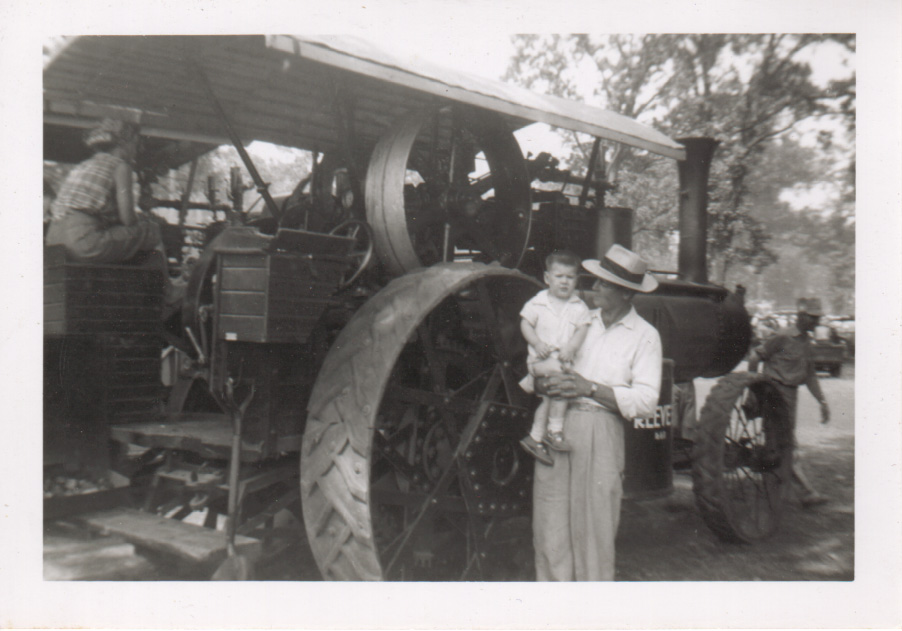
Almost every Labor Day Weekend when I was growing up, my parents loaded the 1950 Chevrolet with a picnic basket, blankets, and thermos bottles, and we headed out for Pontiac, Illinois, and the Central States Threshermen’s Reunion, 100+ miles away. The show featured farm steam engines smoking and whistling on the 4-H fairgrounds. One of the principal purposes for such engines was to provide power to threshing machines, which separated wheat and other small grain from the stalks that they had grown upon and which collected the clean grain. As my father’s uncle had trained my father to run such engines long ago, Dad thoroughly enjoyed the nostalgic rally under the massive oaks. My mother had grown up within a short walk of the Keck–Gonnerman steam engine factory; accordingly, she loved the Kecks exhibited in Pontiac. One of them—an 18 HP owned by Joe Weishaupt—had Donald Duck and Mickey Mouse painted on the bunkers. Of course, I loved it!

Joseph C. Rhode (1918–1999) with Son
Standing Beside Reeves Steam Engine
Owned by Lindenmier Family
At Central States Threshermen’s Reunion
Pontiac, Illinois, 1953

Even though a boy my age was selling hotdogs, we ate our own dinner (as farmers called the noon meal) when all the engines blew their whistles. I had to hold my hands over my ears because I could feel my eardrums imploding from the sound of so many whistles shrieking at close range. Little did I know that the hotdog boy was John Spalding, with whom I would one day write the nonfiction best seller titled The Steam Tractor Encyclopedia.

Back then, my mother served our dinner beside our car. We were not alone. Up and down the lines of vehicles were other families spreading their blankets and munching sandwiches in the shade of the mighty oak trees. We always ate tomato soup and cheese sandwiches. Not a fan of tomatoes, I looked forward to dessert. Mom made the best pies, cakes, and other baked yummies! It was not at all unusual for me to be presented a quarter of an apple pie that bubbled in the oven just the night before. My parents drank coffee; I drank milk. To this day, I can recall the fun of picnicking at Pontiac!

When we strode around the grounds to watch the steam engines, as well as the Rumely OilPulls, we had to glance over our shoulders to be sure no parading engine was sneaking up on us. At the age of four or five, I wandered behind a 16 HP Reeves engine that was parked and being fired by Doris Lindenmier. She and her husband, Lester, were engineers, and both exhibited Reeves engines. Doris turned around, saw me dawdling there, and asked me, “Do you like steam engines?” I was delighted that such a great person as a steam engineer would take notice of me. That day, she planted the so-called “steam bug” in me, although I was 40 before I could afford to buy a steam engine of my own. I took it to Pontiac, and Doris, still showing engines, invited me to follow her in the parade. As our engines proceeded, my tears of happiness were glistening in the sunshine.

To return to my elementary school days, I will mention that, at one of the shows, I admired the 50 HP Case, then recently restored by Sam Haley. Maybe Sam inspired me to purchase a 65 HP Case many years later. His sons, Jim and John, helped me during the steep uphill learning curve of operating a ten-ton steamer. Eventually, they built new bunkers for my engine.

When I was a kid at the Pontiac shows, legends were forming. Some of them I knew then, some I came to know later, and some I never knew. The legendary engineers included such names as Dan Zehr, Milford Reese, Wilbur Collins, Homer Dixon, J. D. Roberts, Art Erickson, Sylvester Fosdick, Ray Ernst, Herb Beckemyer, Russell Helm, and Henry “Father Time” Lucksinger. I could name many more, and I apologize for not naming them all. The Central States Threshermen’s organization was too big for me to name everyone here.

Typically, on the way to Pontiac or on the return trip, Dad changed a flat tire. In those days, flat tires on trips were expected, even customary. One year, Dad’s spare tire also gave out, and a long delay occurred while Dad searched through a town for a mechanic who could patch tires.

In certain years, Dad bought a model for me in the flea market. I still have my Lesney Models of Yesteryear Allchin traction engine, made in England, which I was given at the 1961 Pontiac show and my American 4-4-0 locomotive, which Dad purchased for me at the 1962 reunion—both in their original boxes. I also have a 1904 Spyker automobile in its box that Dad gave me when we attended the Pioneer Engineers Club show in Rushville, Indiana, in 1963.

The trips to engine shows were highlights of my younger years. I get what Pontiac citizen Bert W. Johnson meant when he said in 1968 that the excitement felt at threshing reunions was like “steam bubbling in your veins.”