Robert T. Rhode

Robert T. Rhode
Robert T. Rhode
Showing posts with label Mark Twain. Show all posts

Sunday, January 13, 2019

12. The Fly ... THE FARM EAST OF PINE VILLAGE


Robert was The Fly.

Not the unfortunate fly in the 1958 movie with Vincent Price.

Robert was a hero such as Batman and Robin, who appeared in a series that had recently aired on television. Joe’s cousin Jay had given Joe his Navy Peacoat from World War II, which Jay had outgrown, and Joe passed it along to Robert. At the auction of Flora Farden’s belongings, Robert had acquired a pair of amber dark glasses that were big and round with ivory-colored Bakelite frames. Wearing the black coat and the round glasses with the deep amber lenses, Robert was The Fly.

When Robert helped his father with the evening chores, he flew over gates. Well, he had to scale the gates’ horizontal panels and hop down on the other side, but he did it really fast, as if he were flying! On the other side of the gates, Robert fought crime. Often, he did so by cracking ears of corn in two or by spreading hay in the mangers of the barn.

Even though he missed games on the playground, Robert was enjoying his time in the seventh grade. He enjoyed jumping up when the bell rang and scurrying to his next class in another room. He enjoyed the lessons and the teachers and his classmates. He enjoyed having a locker instead of a desk.

And he enjoyed becoming The Fly after school.

For many generations, students from Rainsville had transferred to Pine Village for their final years of schooling. When Robert entered the seventh grade, a reorganizing brought Rainsville students into his class. A few of the teachers who had devoted their careers to Rainsville’s classes permanently transferred to Pine Village. One of them was the beloved Mr. Charles Lloyd Cavanaugh.

He stepped from a story by Washington Irving. A thin gentleman, he parted his gray hair in the middle. His reading glasses slid down his long nose. To see him on a windy day striding between the school building and the gymnasium was to see a scholar of skin and bones barely able to keep his footing while his trousers and coat flapped as if they might lift him into the sky.

Mr. Cavanaugh was named the sponsor of Robert’s class, and Mr. Cavanaugh remained the class sponsor all the way through the class’ senior year.

He taught English and mathematics. While Mr. Cavanaugh was of the old school that memorized everything and seldom (if ever) erred about a fact, he occasionally lapsed into an extraordinary pronunciation.

Once, Robert’s class was learning a mathematical principle when Mr. Cavanaugh thought an example might prove helpful.

“Let us say you have four cassaws,” Mr. Cavanaugh said. He went on to describe a mathematical equation involving the four “cassaws.” Then he called on one of the sharpest students—probably because he wanted the class to hear the correct answer—but the student blushed and apologized, saying, “I’m sorry, but I don’t know.” Mr. Cavanaugh said, “That’s quite alright,” and he called on another student good at math. Fidgeting, the student said, “I don’t know, either.” Now Mr. Cavanaugh wondered what to do. He had hoped to demonstrate the mathematical principle so clearly that the class would see how very simple it was, but he had called on two students who should have known the answer and they had been unable to respond.

Meanwhile, Alan, with knitted brows, had been staring at his desktop. Suddenly, a smile flashed across his face, and he raised his hand.

“Yes, Alan,” Mr. Cavanaugh acknowledged.

“Mr. Cavanaugh,” Alan began, clearing his throat, “by your word ‘cassaws,’ might you mean cashews?”

“I mean those delightful nuts that can be found along with peanuts in a can of mixed nuts,” Mr. Cavanaugh replied innocently, not taking any offense at Alan’s question. The idea of taking offense at anything never could cross Mr. Cavanaugh’s wonderful mind.

At that moment, the student on whom Mr. Cavanaugh had first called, raised a hand, was acknowledged, and said, “Now that I know we are dealing with cashews, I can give the answer.” And the answer was correct! Mr. Cavanaugh beamed, and he went on to say how simple the principle was, after all.

From that day forward, Robert always thought of cashews as “cassaws.”

Robert liked every one of his classmates—and had since first grade. He was delighted that he liked all the new classmates that came from the Rainsville School, too. Among them was his cousin Pam. They were complementary in many ways. Pam’s hair was as dark as Robert’s was blond. Her complexion was olive, but Robert’s was pale. When Robert was serious, Pam would laugh, and, when Pam was serious, Robert would laugh. They initiated a mutually pleasant academic rivalry that, six years later, would bring Robert to be the Valedictorian and Pam to be the Salutatorian—with the two separated by hardly a difference.

In seventh grade, Robert relied upon Pam’s customary response to any of his ideas that she considered outrageous; “Now, Robert!” she would admonish him with her genuine smile. He continuously amused her, and, as she was so intellectual herself, she always kept him on his intellectual toes.

For Mr. Cavanaugh’s English class, Robert drafted a letter to Aunt Della in Georgia: "Several events have been happening on the farm. Pigs have been coming, chickens hatched, young calves have been born, and a zillion other creatures have entered into our life. I enjoy it all except for one thing—work! It takes energy to feed a mess of squealing pigs and squawking chickens. It’s work to get clean again; although I suppose it’s worth it."

To Robert, the year felt as if a long-awaited future had arrived to pay homage to the past. The fall was distinguished by a futuristic television series named Star Trek that acknowledged its roots in Old World myth and fable. The hallmark of the spring was the CBS telecast of Hal Holbrook’s stunning performance as Mark Twain. (In the distant future, Robert would meet Hal Holbrook and would tour the eastern half of the United States as Edgar A. Poe for over two hundred performances, and Robert would spend two days with—and sketch—Gene Roddenberry, the creator of Star Trek.)

Meanwhile, Joe called out, “Robert, it’s time to do the chores.”

“Robert?” Robert called back. “Who’s Robert? Don’t you mean The Fly?”


Sunday, May 31, 2015

My Summer in a Garden: Planting Day

In 1870, Charles Dudley Warner (1829–1900) published My Summer in a Garden, a book that memorialized Warner’s gardening experiences and that elevated his cat named Calvin to nearly heroic status. The essays comprising the volume first appeared in serialized format in The Hartford Courant. The author’s name might have been that of a character in a 1930s Hollywood movie: a person of delicacy, refinement, and hauteur, the sadly inevitable accompaniment to such refinement and delicacy. Only three years after Boston’s baronial publisher James R. Osgood placed Warner’s gardening book in the hands of appreciative readers, Warner collaborated with Mark Twain in that groundbreaking work entitled The Gilded Age: A Tale of Today. As a subscription book from the American Publishing Company of Hartford, Connecticut, The Gilded Age broke the bonds of Brahmin imprimatur by appealing to middle class readers everywhere.

Cover of 1898 Riverside Edition 
Of Charles Dudley Warner’s My Summer in a Garden

Such splendid chutzpah! To co-author a work with Twain, famed author of Innocents Abroad and Roughing It, required self-confidence or a reasonable facsimile. Having worked as an editor in Hartford, Connecticut (Warner was buried in Hartford’s Cedar Hill Cemetery; Twain was a pall-bearer.), Warner and Twain shared a love for Hartford. Twain moved there in 1871 and began construction of his elaborate house (https://www.marktwainhouse.org/) in the same year that the author of “The Celebrated Jumping Frog of Calaveras County” joined Warner in publishing The Gilded Age, the title of which became an epithet for the late 1800s: an era of deep social problems and wide aristocratic corruption hidden behind a thin golden veneer of rich sophistication. Warner and Twain shared more than a passion for Hartford; they were leaders in a growing movement to cause literature to imitate life realistically. Despite their campaign for such literary realism, which fought against the Romantic tendency to moralize, they carried the banners of their Puritan and Presbyterian upbringing when they sought a moral standard capable of saving a nation from evil.

Cover of My Copy of the First Edition of The Gilded Age 
By Charles Dudley Warner and Mark Twain
And the Elegant Cursive Handwriting of the Book’s First Owner

But all of this background is meant simply to introduce a series of blogs about my vegetable garden for this year. I see myself as embarking on a project not unlike Warner’s “summer in a garden.” Unfortunately, I have no cat Calvin (with a name invoking that of John Calvin, the exponent of Presbyterian predestination) to lighten the tone. Apparently, I do have chutzpah sufficient to set my blogs alongside the work of Warner, who served as an editor at Harper’s Magazine during its heyday. It was Warner, not Twain, who said, “Everybody complains about the weather, but nobody does anything about it.” In his introduction to My Summer in a Garden, Warner writes, “These garden letters began to blossom every week … .” I hope my blogs will bloom similarly.

I will begin with the weather that Warner mentioned. Soon after I planted my garden on May 2nd, a Saturday, temperatures warmed considerably. Seeds that might have taken two weeks to sprout were poking above the ground after only seven or eight days! I found myself carrying buckets of water from the hand pump to the rows so as to give proper encouragement to the infant plants. I am ahead of myself, though.

Hand Pump and Buckets for Watering My Garden

Let me return to Planting Day. My friend Steve had plowed my garden, and the soil was just right: rich and fluffy. I walked on pillows.

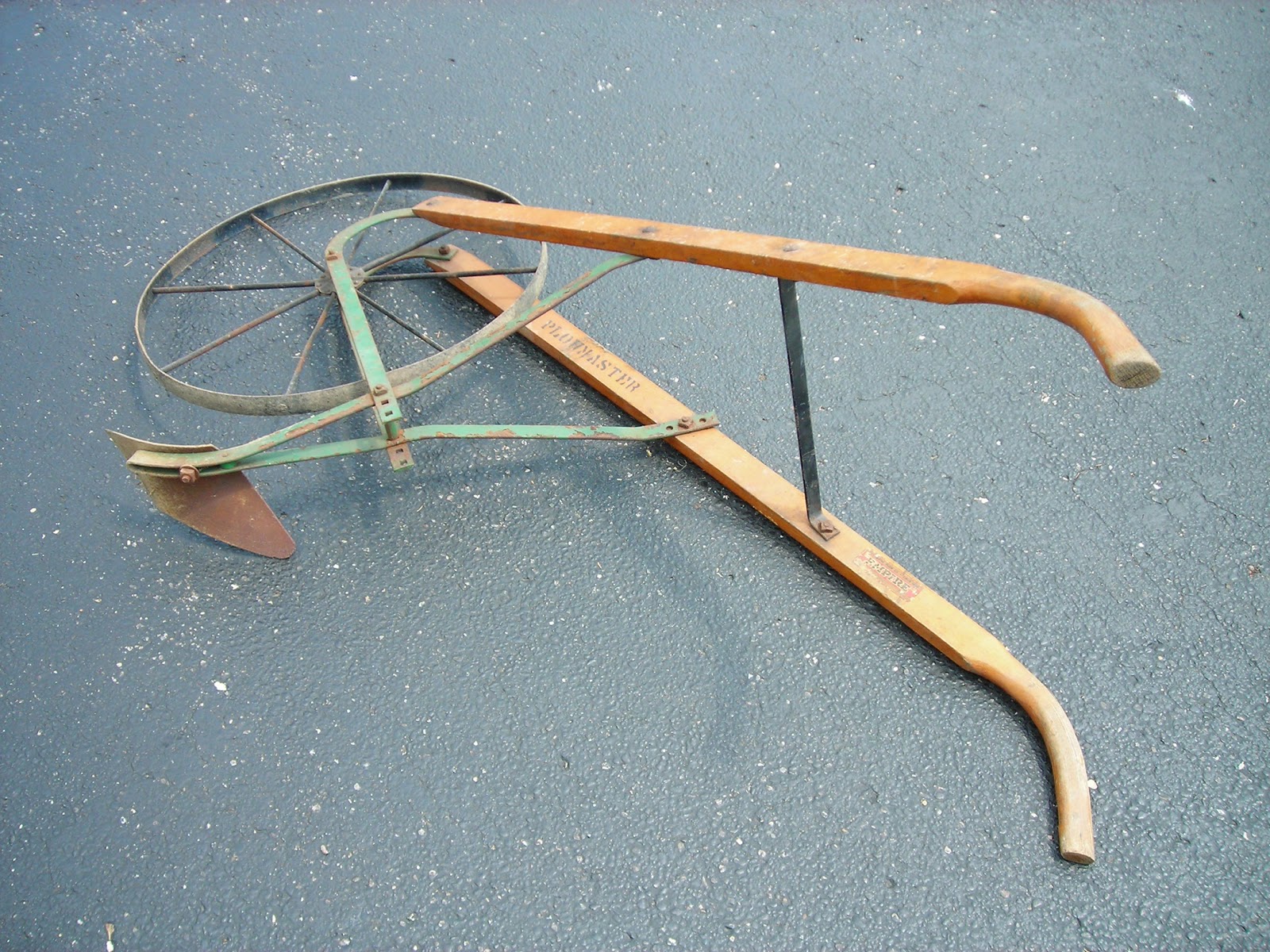
Plowmaster, Manufactured by “The Empire Plow Co. · Since 1849” 
And Distributed by the American Hardware & Supply Company 
Of Pittsburgh, Pennsylvania

My single-wheeled plow has one of the best jobs there is. It has to work only one day out of the year. It plows my rows on a glorious spring morning. Then it rests from its labors until another year rolls around. I use a Plowmaster, manufactured by “The Empire Plow Co. · Since 1849,” as the still-visible decal proclaims. According to a stencil along the inside of one of the handles, my plow was distributed by the American Hardware & Supply Company of Pittsburgh, Pennsylvania. Here are the Burpee’s seeds I carefully installed at precisely the correct depth and exactly the proper spacing—well, I tried to be careful, precise, and exact:

BEET Detroit Dark Red, Medium Top
BUSH BEAN Beananza
CARROT Mokum Hybrid
CUCUMBER Palace King Hybrid
MESCLUN Sweet Salad Mix
SUMMER SQUASH Cosmos Hybrid
SUMMER SQUASH Burpee’s Hybrid Zucchini
WINTER SQUASH Early Acorn Hybrid

FOUR O’CLOCK Marbles Mix
MARIGOLD Climax Mixed
SUNFLOWER Elegance
TITHONIA Sundance
ZINNIA Giant-Flowered Mix

The flowers, great for bouquets, will form a single-row border around my garden. I forgot to reserve space for an entrance, so I may have to step through the blossoms to reach my vegetables later on. Things could be worse than having to pass among petals to snap a fresh cucumber from its vine.

Those readers who follow my blogs know that I plant only those vegetables that my wild friends (rabbits and raccoons) generally ignore. I fully expect most of the leaves to be chewed off my bush beans, but I have found that the stalwart Beananzas need only a few leaves to function as reliable producers of beans for my dinner table. 

Turquoise Sky Above My Just-Planted Garden

I left room for eggplants, peppers, and tomatoes to be set out whenever good specimens are on sale. While planting, I often took the time to appreciate my surroundings: the playful breezes, the turquoise sky, and the exuberant melodies of the wrens. 

Rocks Marking Rows of Seeds 
And Areas for Plants to Be Added Later

I recognize the song of the wren. Alas, I am not yet schooled in identifying the voices of all the birds, but I will learn to name several of them this summer. From my present vantage point, the summer stretches happily toward infinity.