Robert T. Rhode

Robert T. Rhode
Robert T. Rhode
Showing posts with label Chevrolet. Show all posts

Saturday, May 18, 2019

30. The Corn ... THE FARM EAST OF PINE VILLAGE


In the spring, Robert was privileged to help his father plant corn, as well as soybeans. If the disking were finished, Robert waited beside the Chevrolet pickup until it was time to restock the four-row planter. From a bag, he poured corn—coated pink with captan—into the hoppers, which were covered with neat lids. When a bag was empty, he dropped it behind the planter and placed a heavy clod on the bag to hold it against the wind and not have to go chasing it across the field. He opened bags of fertilizer, which had a lightly acrid scent. Robert thought that, if a rock could rot, it would smell like that. The fertilizer was poured into the receptacles behind the corn hoppers.

Joe would start back through the field. He would pull the string that tripped the arm that dropped with a pleasant metallic sound to one side, so that the small disk at the end of the arm could spin and send up a little cloud of dust while it laid down a groove that would enable Joe to know exactly where the nose of his tractor should go for the return trip through the field.

The warm sky was bright azure. White clouds like cotton balls sailed along. Birds sang in the narrow thickets beside the field. The sunlight was vigorous. To be outdoors and breathing such fresh air was a joy. Spring planting days afforded pure contentment!

Next came the cultivating, which Robert tolerated—especially after he “got on the wrong rows” the first time and eradicated corn for a distance the length of two tractors before he managed to stop. Robert learned to cultivate. He had to! But cultivating corn was an acquired skill, analogous to an acquired taste. He had to be ever vigilant so as not to wipe out corn plants, and such attention to detail interfered with his preference for exercising his imagination while daydreaming.

In the fall—sometimes as late as Thanksgiving—Joe picked corn. On a cool day, wearing his boots—each with four buckles that looked like miniature furnace grates—his blue denim coat, and his warm corduroy cap with ear flaps, he first strode into the field among the cornstalks, pale yellow, tan, and dry. The stalks were spaced a few inches from one another, and the rows were fairly widely spaced—enough for Joe to pass between two rows without having to brush the leaves aside. Selecting an ear, he pulled back the husks to examine the corn. Through experience, he could detect whether the corn might be ready for harvesting. He tried another ear and another, holding between his elbow and his ribs those ears that he had already examined. Later, he broke the ears into thirds and gave the pieces as treats to the cows.

The skies already hinted at the winter to come; it was a pale Turkish hue with cold-looking, vague streaks of cloud lacing them. The daylight seemed strained through thin silk. Joe tramped back to the barn and set down the ears of corn he had collected. He backed a tractor up to his two-row pull-type corn picker parked under the leafless hedge apples. After hitching up, Joe had returned to the seat of his tractor in a jiffy. All that remained was to hitch the tractor and picker to a wagon. Joe was excellent at backing up and often tried to explain the intricacies to Robert, who could not comprehend where the tongue of, say, a corn picker would go while the tractor reversed.

Then Joe went to the field with his tractor, corn picker, and wagon in procession.

With the air just cold enough to turn his cheeks rosy, Joe started into the field. Ears of corn began falling from the elevator of the corn picker into the wagon. Two rows at a time, Joe slowly passed through the field. The corn harvest was underway: the reward for the hard work and the expense of planting and cultivating.

Picking corn was a one-farmer job, so Joe picked corn alone. Robert could not help. Besides, corn picking was considered too dangerous for Robert. Although he could not help, Robert enjoyed coming to the field to watch his father and to chat with him for a few minutes. Robert thought the corn picker resembled a weird rocket with three noses.

As evening drew in, the sky turned yellow with a touch of chartreuse. Near the horizon, orange with traces of rose spread into pink haze above a mauve tree line far away. Indistinct gray masses of cloud hung motionless just above the distant farmhouses and barns.

Joe pulled the last wagon of the day toward the barn, where he would store it temporarily.

For the rest of his life, Robert would cherish the memory of his father picking corn as if Robert were looking at an old snapshot in a picture frame.    

Saturday, December 19, 2015

Vehicles I Remember: 1963 Chevrolet (Last Installment in This Series)


Around 1966, my parents thought they needed a car with fewer miles than their 1957 Chevrolet had. They turned to the Dowdens, who were selling a 1963 white Chevrolet Bel Air. A generation earlier, Milton Dowden had been a sign painter in town; his son, Milton L., who went by “Milt,” could hang wallpaper better than anyone! Milt’s wife, Elsie, had given my mother a recipe for sour milk drop cookies that my mother included among her favorite desserts. My father and mother respected—and liked—the Dowdens very much. I recall almost no deliberation about the automobile; my parents bought it right away.

The 1963 Chevrolet Bel Air, an IH 560 Tractor,
Brothers Ready for School, and a Fox Terrier

My mother and father enjoyed the 63 Chevy more than I did. The aesthetics of the design did not appeal to me. There was something about the look and feel of the ceiling fabric that turned me off. The color was light aqua. The material felt like plastic, and it had a pattern of tiny circular holes. What can I say? After experiencing the interior of the 57 Chevrolet, the 63 seemed cheap inside. The seat covers also struck me as anything but luxurious. Even the exterior lines of the vehicle made me feel that Chevrolet had lowered its design standards. We were riding in a thin horizontal box with a roof and windows that projected above the box. The lack of chrome and the plain round taillights seemed to proclaim that everything about the car was cheapened to the lowest denominator.

As far as I remember, the car was dependable. It did not languish for long periods of time in Glen Bisel’s shop; rather, it ran and ran in its bland, undistinguished way. My family rode in its cheapness from place to place for many years. The white car reminded me of sour milk: that is, sour milk by itself, not as an ingredient in Elsie Dowden’s delicious cookies!

At the end of its life, the car faded into obscurity, replaced by a 1966 Pontiac Catalina that my parents and I loved. Typical of the Chevrolet was its unremarkable demise; I cannot remember what became of it.

I do fondly recall Elsie Dowden’s cookies, however! Here is her recipe:

Elsie Dowden’s Sour Milk Drop Cookies

Ingredients

1 cup shortening (butter and lard combined)
2 cups brown sugar
2 eggs
1 cup sour milk (or buttermilk)
1 cup raisins, chopped
½ cup chopped walnuts
4 cups flour
1 tsp nutmeg
1 tsp vanilla
½ tsp salt
1 tsp baking soda
1 tsp baking powder (heaping tsp)

Directions

Preheat oven to 375°. Cream shortening and sugar. Add beaten eggs. Dissolve baking soda in milk. Sift flour, heaping teaspoon of baking powder, salt, and nutmeg together. Mix all and add floured nuts and raisins. Drop from spoon onto buttered baking sheet. Bake for ten minutes or until the bottom edges begin to turn lightly brown.
  

Sunday, December 13, 2015

Vehicles I Remember: 1957 Chevrolet


I felt proud of the 1957 two-door Chevrolet Bel Air Hardtop Coupe that my parents bought when the car was only a year or two old with very few miles on it. The car sported fins and futuristic hood ornaments reminiscent of rockets. As a kid, I enjoyed waxing the car, but, invariably, I pinched a finger when making rapid passes of the polishing cloth under those hood rockets. I just couldn’t learn to avoid cramming my finger back too far! Ouch!

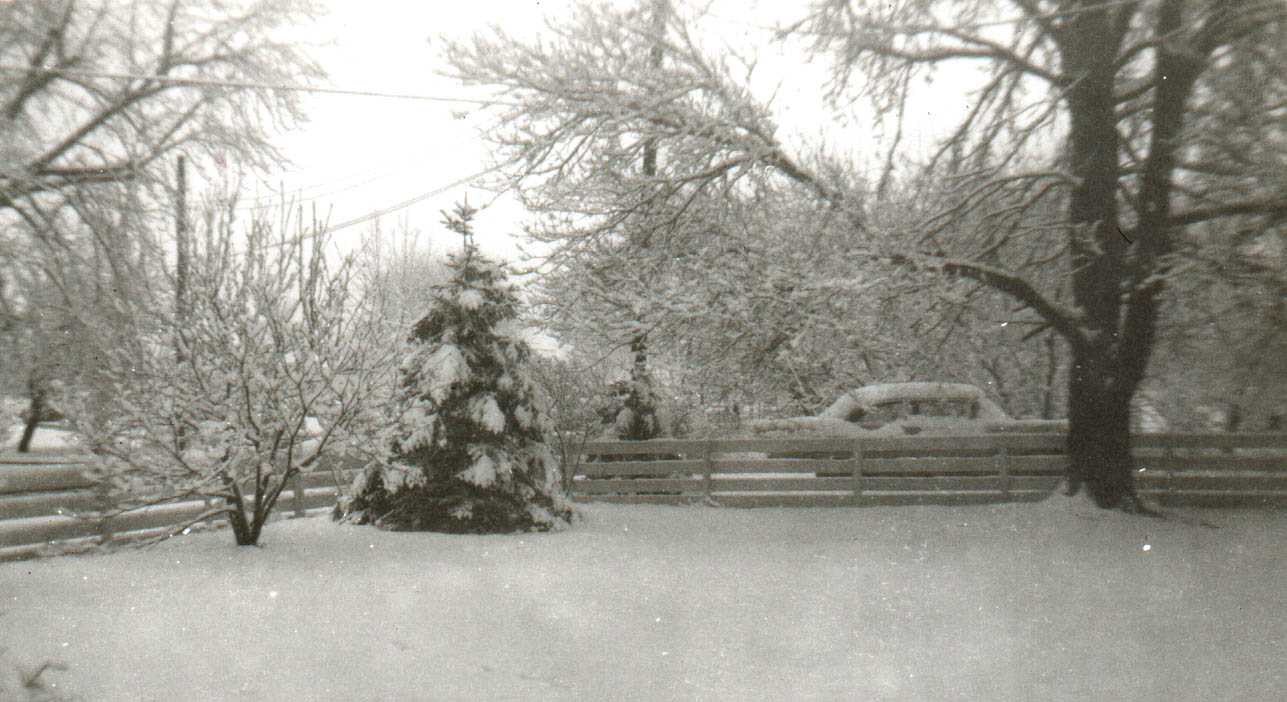
1957 Chevrolet Bel Air Coupe in a Pine Village Winter

The roof was white; the body was pink, not the coral color that many people today insist was the only “pinkish” color in the 1957 Chevrolet lineup. The abundance of chrome was nothing short of magnificent! What a splendid show the automobile made at the drive-in movies and drive-in restaurants!

Chevrolet Bel Air with Original Pink Paint, Not Coral

It happens that my parents’ ownership of the ’57 Chevrolet coincided with one of the happiest times of my childhood. My family drove to Lafayette, Indiana, more than once a week for various activities, such as shopping at Graves Bakery, the Ayres branch in Market Square, and the new Smitty’s Supermarket. The Chevrolet faithfully took my brother and me to piano lessons. My family attended concerts and plays, and we visited Battleground and Fort Ouiatenon. What fun we had!

During the summers, the Chevy made frequent trips to Williamsport for the county fair. Every Christmas, the car took us to the Purdue University Christmas Show, which was wonderful each and every year! The Chevrolet was a major contributor to our life. In many key respects, we had a life because of the Chevy!

Unfortunately, I am prone to motion sickness. I always begged my parents to permit me to sit in the front seat, where I was less likely to be plagued by the dizziness and resultant nausea. Of course, my father and mother wanted to sit next to each other in front, and they were dismayed to relinquish the front passenger seat to me again and again. I often had to be tough and try to survive a trip seated in back. One time, I told my parents that I was feeling ill. We were returning from Lafayette and were nearly home. My mother urged me to keep calm until we pulled into our driveway. As my father turned off the highway, I vomited onto the floor in back. I couldn’t have waited another minute. My mother volunteered to clean the car. As the Chevy was a two-door model, she had a difficult time reaching around the front seat to shampoo the carpet in the floor well of the back seat. For a long time, the car had an odor that was partly the result of bacteria that grew in the carpet, no matter how frequently and skillfully my mother mopped the nap. I deeply regretted what had happened, but, to this day, I know that I could have done nothing differently.

Eventually, my parents decided that the ’57 Chevy had enough miles and that they should find another car. My father kept the Chevrolet; in fact, he still had it in his garage in the 1970s. It was parked beside the Hudson and the Packard. My father called me at Indiana University and said that he would like to sell either the Packard or the Chevrolet. Naively, I thought the Packard would be worth more down the road. With only mild hesitation, I advised my father to sell the Chevy, which he promptly did. What a mistake! That Chevy would soon have been worth far, far more than the Packard, the value of which steadily declined. Oh, well! Lesson learned!    

Sunday, November 15, 2015

Vehicles I Remember: 1950 Chevrolet


The first car in my memory was a 1950 Chevrolet. It was black. In front of the regular windows on the driver’s side and passenger’s side were triangular windows (wing vents) that could be turned in such a way as to force a blast of wind against the face. That breeze felt so good on a hot day! The windshield was in two halves joined by a thin metal connector moulding. As a child, I always experienced motion sickness, which was far worse if I were in the back seat. Even when I was lucky enough to sit in front, my eyes would focus first on the metal moulding then on the distant view then on the connector again, until I was well on my way toward nausea!

My Mother, My Brother, and the 1950 Chevrolet

My parents drove differently. My father was far-sighted and enjoyed perusing fellow farmers’ fields to his left. Meanwhile, he slowly veered the car to the right until the right wheels were off the road and onto the berm. Miraculously, he never lost control of the vehicle but gradually brought it back onto the pavement, only to repeat the experiment immediately. My mother, meanwhile, played with the throttle. Her small foot, usually wearing a flip-flop in summer, wore out the gas pedal by depressing it and lifting up right away, depressing it and lifting up right away. The car lurched forward and hesitated, lurched forward and hesitated accordingly. To ride with my father at the steering wheel was less nauseating but more frightening.

One day in the good old summertime, I was riding with my mother at the wheel. Down went the gas pedal, up it went, down it went again, back up it came, and so on. I was a youngster still short enough to stand on the front seat. I was near the passenger door and was trying to keep my balance while the car briefly gained speed and momentarily slowed, gained and slowed, gained and slowed. I remember being slightly dizzy. I could smell my mother’s new permanent. (She had to have curls in her straight hair!) We were lurching and hesitating along a gravel road lined by tall corn on our right. We came to an intersection with another gravel road. My mother obeyed the stop sign, but the corn was planted so close to the road that she could not see around it. She entered the intersection only to discover that a road grader had almost entered the intersection from the right. The big machine had been hidden behind the corn. My mother slammed on the brakes, and the road grader just missed the front bumper!

The sudden braking made me lose my balance. My mouth struck the hard metal dashboard. I lost both of my upper baby teeth in the front. My mother yelled, “Why don’t you ever stand close enough to where I can grab you?”

A long time after the incident, when my two permanent teeth came in, they were separated by a gap, or diastema. Whether I liked it or not, the diastema became a trademark. I still have it, although the gap has lessened over the years. Terry–Thomas was a popular British comic film actor in American movies of the 1960s. I always enjoyed his performances because, like me, he had a pronounced diastema.

I am old enough to be mindful that young people today have such perfect teeth! When I was growing up, children lacked such gloriously white, exactly spaced teeth, the result of costly orthodontics. (Incidentally, antibiotics given for ear infections, from which I frequently suffered, turned children’s teeth yellow.) Visiting an orthodontist was just becoming an option for rural kids back then. My parents took me to one in Lafayette, Indiana, but, when they learned how expensive it would be to close the diastema in my front teeth, they asked me if I really wanted to have my incisors properly aligned. I hated dentists. With vast relief, I said that I would just as soon avoid going to the orthodontist. Also relieved, my parents did not have to pay the thousand dollars to close the gap in my teeth.

Whenever I brush my teeth, I recall the dashboard of that 1950 Chevrolet.