Robert T. Rhode

Robert T. Rhode
Robert T. Rhode
Showing posts with label books. Show all posts

Sunday, February 15, 2015

Why I Plant Night-Blooming Cereus


The night-blooming cereus, a kind of cactus, was a favorite conservatory plant in my grandparents’ generation. While various plants have been called “night-blooming cereus,” only one kind was universally adopted among the women of my hometown. It was nicknamed Christ in the Manger. The popularity of the plant may have received a boost from the mounting of a special exhibition of night-blooming cereus at the Columbian Exposition in Chicago in 1893. As many people from my village traveled to Chicago to participate in the celebration of Columbus’ discovery of America, they may well have obtained specimens of cereus that were the ancestors of my plant.
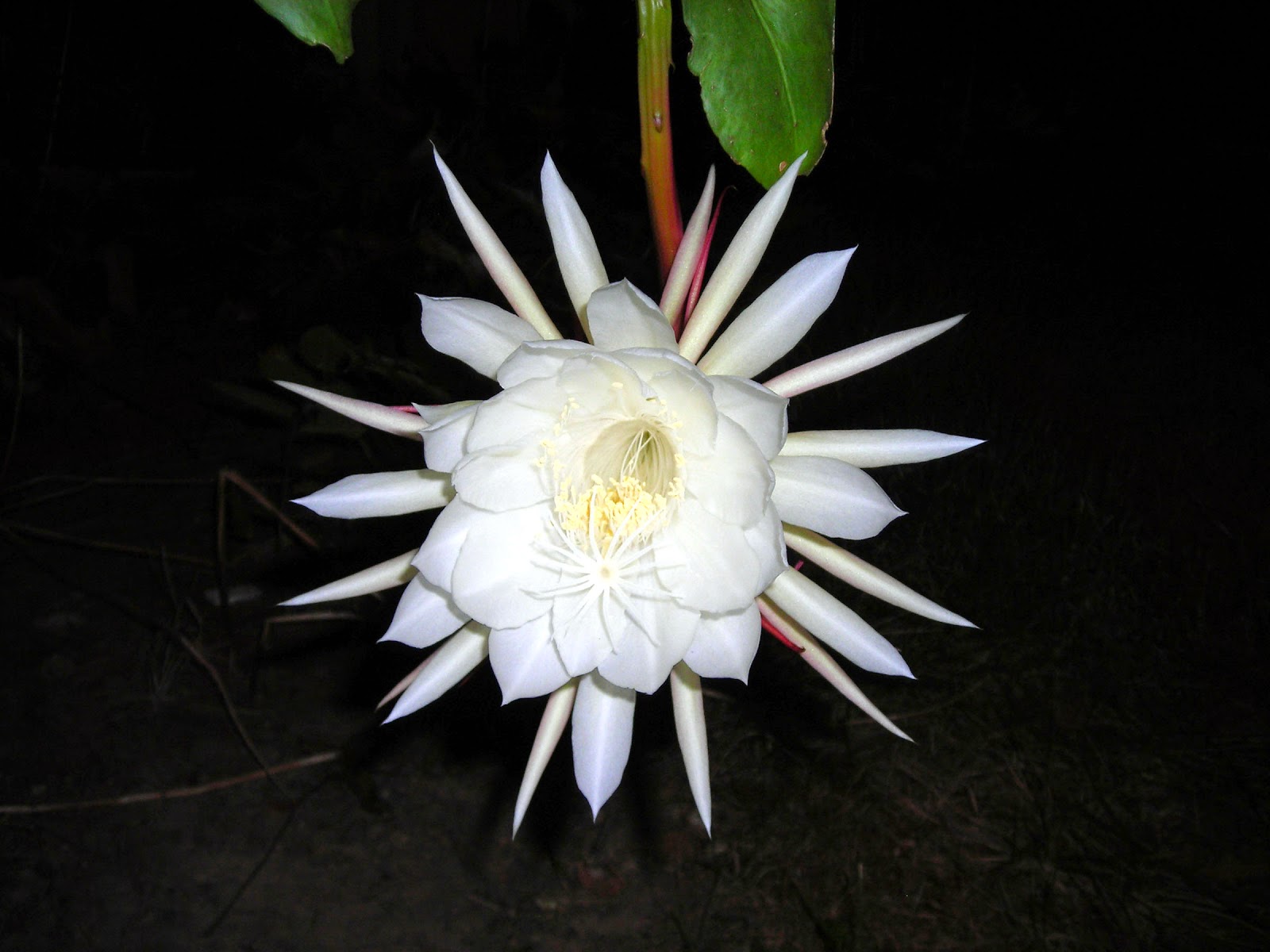
My Night-Blooming Cereus in Joyous Display

The flower opens for only one night, usually after midnight, and the petals are found withered and drooping by sunrise. I have heard of Victorian families staying awake to watch the opening of the flowers. A single luxurious plant can have well over a dozen blooms, but mine has had no more than three at a time.

Long ago, the plant was considered to have medicinal value. It was mentioned in Joseph H. Wythes’ The Physician’s Dose and Symptom Book (12th Edition, Philadelphia: Lindsay & Blakiston, 1875). Please understand that I am not endorsing the medical value of night-blooming cereus when I quote from The Pharmacology of the Newer Materia Medica (Detroit: George S. David, 1889): “Sedative and diuretic; especially useful in functional diseases of the heart, attended with much irregularity of action, in which it exerts a decided action, palliating or removing the symptoms and frequently giving prompt relief. It has been found serviceable in palpitation, angina pectoris, cardiac neuralgia, rheumatism, valvular disease, also of hemoptysis, dropsy, and in threatened apoplexy.” The book gives several case studies, including this one: “Mrs. McSwain, a lady about fifty years of age, nervous temperament, and formerly of Minnesota, called me in to see her. I found her with violent palpitation, cold extremities, clammy sweats, and great prostration. I examined the heart carefully, and found the distinct bellows sound, and rapid pulsations of an enlarged heart from dilatation. … I prescribed [cereus] in five-drop doses, every two or three hours, alternated with collinsonia, in doses of ten drops, three or four times a day. Under this treatment she rapidly improved, until she regained her health and returned to her home in the northwest.” I have no idea if the plant had anything to do with the restoration of Mrs. McSwain’s health, although I am delighted that she recovered from her illness. I have quoted her case because I find the old-fashioned medical lingo so piquantly redolent of an earlier era!

You need only a little imagination to perceive the Christian symbolism. In the center of the plant is the Christ child upon the yellow straw of the manger. Angels in white raiment have gathered around; above them is the star of Bethlehem.

I inherited my night-blooming cereus. I have simply watered it for many years, and it seems happy enough. Websites describe the care and feeding of the night-blooming cereus, and I direct you to them. Why? Because I really have no idea how I have prompted my heirloom plant to bloom. It has set on flowers in some years and not in others. I need to read the websites myself so as to learn how to encourage my plant to develop blossoms.

I can tell you that the flowers are large and heavy, in a sense. In a way, it is surprising how they can quickly wilt into lightweight nothingness after such spectacular blooming. For some, the blossoms may demonstrate a wistful aphorism such as all good things must come to an end, but I prefer to think that the flowers are dazzling like sunup dispelling darkness while anticipating the actual sunrise in all its splendid symbolism; as such, they are an inspiration!

Sunday, January 25, 2015

Why I Plant Tulips


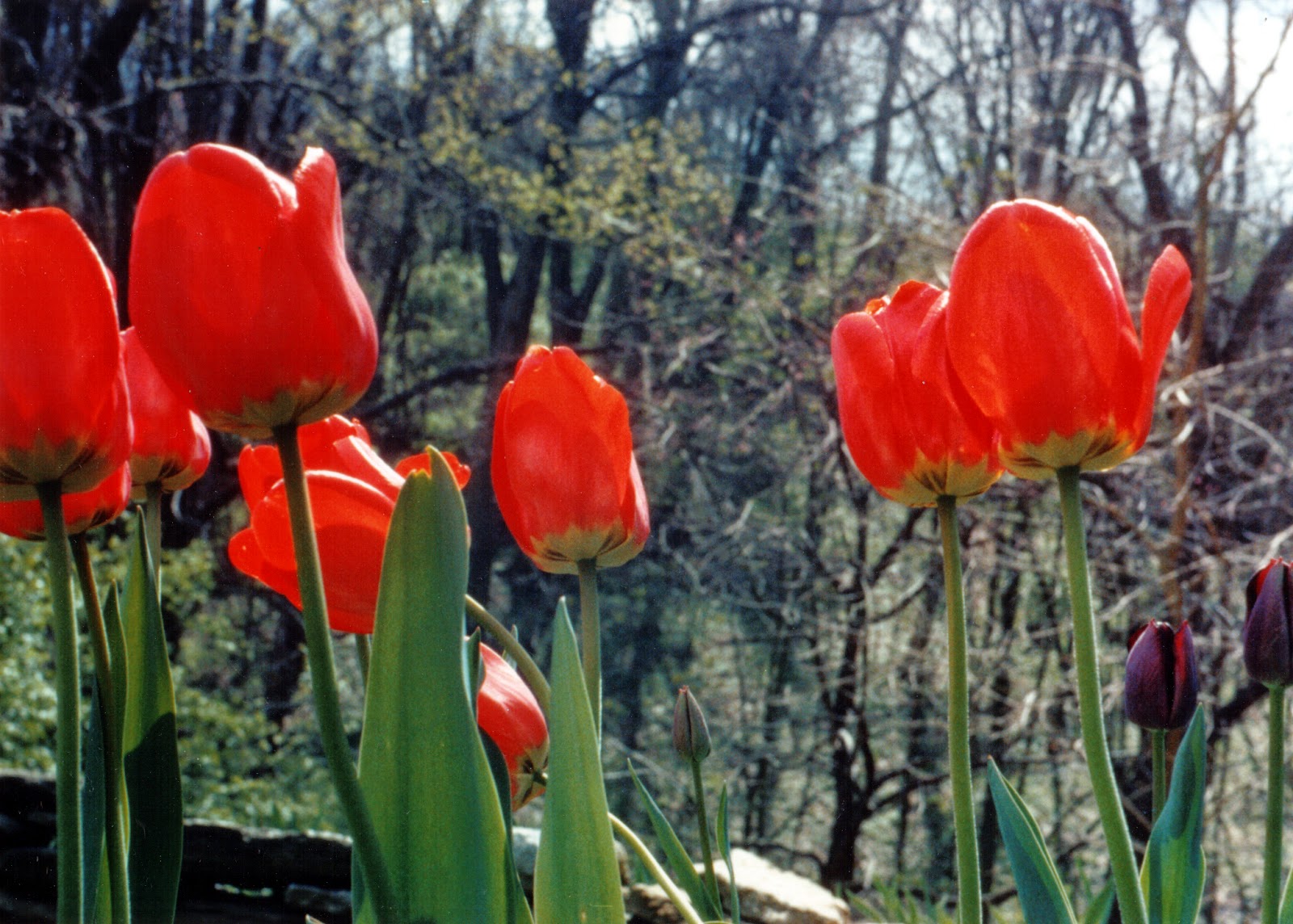
For those subscribers to my blog who are experiencing the snow and chilling winds of winter, views of flowers might come as a welcome surprise. One of my cherished memories of my grade school years is walking home from the school, which stood across the road from our house. My route led down our driveway. My mother, who loved blossoms of all kinds, had planted spring bulbs along the graveled path that the 1957 pink two-door Bel Air Chevrolet followed to its parking spot. As the school year was drawing to a close, the sunny afternoons between the April showers found me striding past the profusion of hyacinths, daffodils, and tulips that my mother had crowded into a deep border. The petals nodding in the breeze invited me to slow my steps so as to pay closer attention.

My Tulips Proclaiming the Return of Spring
I observed the unexpected variety of daffodils: tall, short, early, late, long trumpets, compact trumpets, yellow, white, and orange. Naturally, I decided which daffodil was my favorite, and, naturally, I changed my mind the next afternoon.

I bent close to the hyacinths to enjoy their perfume. Such heavenly scent! Closing my eyes and smiling, I caught the delicate fragrance of the tulips. Each kind of tulip possessed its own exquisite bouquet. I don’t expect anyone else to understand this, but I connected the tulip scents with marshmallow Easter egg candies.

To this day, I can see in clear detail my grade-school self standing among the flowers. I am wearing my gray zippered jacket and my blue stocking cap. A book is in my left hand. The daffodils and tulips have diverted me from my walk to the house; I stand among the blossoms. Later, in the hot summer months, this border beside the white board fence will be in dappled shade, but now, in the pastel spring, the leaves to be are merely buds, and the twigs and branches of the trees cast no deep shadows. What a pleasure it is to take the measure of the renewed world! By patiently burying bulbs in cold, blustery November, my mother had planted wonder and delight to flourish when a child’s soul most needed them after the winter months of lessons and tests.

At about the same time, my mother ran the incubator in the enclosed breezeway between the old smokehouse and our home. Chicks and ducklings hatched from the eggs she had patiently candled, turned, and warmed. One of her favorite games was to bring a newly hatched duckling to wake me up for school. I would gradually relinquish the dream world while listening to the peeping of a duckling that Mom was holding close to my ear.

As my mother had taught elementary school before raising a family, she felt a special affinity for teachers and students, and she always invited a few of the grade school teachers to lead their classes across the street to file through our breezeway while learning about incubators and new life fluffing itself among broken shells.

Although I have loved every period of my life, my grade school years occupy a special place in my estimation, and the flowers of the springtime are the hallmarks of my memory.

Wherever I have lived, I have planted bulbs. No matter how tiring it is to prepare the soil bed for the bulbs, to orient them in the right direction, and to cover them with soil that, by November, has begun to turn cool to the hand, I return to the job of planting bulbs. They are the promise of the days and the blooms to come. They are the symbols of my connection to the earth and my potential for surprise. They are the responsibility I have to the arts inspired by nature. By planting bulbs, I acknowledge that I am a steward of the earth and a practitioner of its grace, its elegance, and its charm. When I am treated to the first daffodil blossoms of the spring, I feel the peace of symmetry between plant and planter. 

Sunday, January 18, 2015

Recipe for Snickerdoodles Gone Bad (Last Installment in This Series)


My grandmother and my great aunt baked the best cookies I have ever tasted. Their generation (born before 1900) knew cookies! When I was a boy, one of the towering pleasures of attending Vacation Bible School was to line up in the cool church basement on a hot spring day and to be served two cookies prepared by my grandmother and by other women of approximately her same age. How they discovered the secrets of baking is beyond me, especially when I consider that they learned to bake in hulking iron stoves with ovens fired by wood and without thermometers.

My Grandmother
Who Survived the Flu to Give Birth to My Father

While I would have a difficult time choosing a favorite cookie, I could be forced to declare my grandmother’s sugar cookie the best of the best. All her recipes have been passed down to me. There are dozens of sugar cookie formulations. I have prepared several of them, but they do not produce the cookies I remember. I keep hoping that the special sugar cookies are hiding among the recipes, but I have not yet found them. I am beginning to think that my grandmother was so adept at making them that she needed no recipe.

My Great Aunt Margaret and My Grandmother
Who Learned to Bake Cookies on Iron Stoves

Now and then, a mistake in cooking yields a delectable surprise. I once made a blunder in a snickerdoodle recipe and wound up preferring the result. The ingredients (below) include more butter than the original recipe required. My error occurred when I was doubling the recipe; I doubled the butter and forgot to double the rest of the ingredients. (Yeah, I goofed when multiplying by two. Maybe you can deduce why I did not become a math teacher.) The extra butter causes the cookies to flatten, but they have a melt-in-your-mouth crumb that is delicate and delicious. I call them “Snickerdoodles Gone Bad”!

Ingredients

1½ cup butter softened at room temperature
1½ cups sugar
2 eggs
2¾ cups all-purpose flour
2 tsp cream of tartar
1 tsp baking soda
¼ tsp salt
2 tsp cinnamon and 2 Tbsp sugar combined

Directions

Mix at medium speed in a large bowl the butter, sugar, and eggs until light and fluffy (at least 2 minutes). Combine in a separate bowl the flour, cream of tartar, baking soda, and salt. Add these to the creamed mixture and blend them well. Refrigerate the dough at least 30 minutes. Preheat the oven to 375° and combine the cinnamon and sugar. Shape the dough into 2 balls and roll them in the cinnamon and sugar. Bake the cookies for 12–15 minutes on an ungreased cookie sheet. The tops of the cookies will puff up at first then flatten. Creases will form, and the edges will brown slightly.