On Labor
Day Weekend each year, Joe drove the family the hundred miles to Pontiac,
Illinois, to attend the Central States Threshermen’s Reunion. The event
featured around fifty steam engines, half a dozen OilPulls, and several big
prairie tractors. Every day, a steam engine was belted to a thresher for a
demonstration of steam-powered threshing. As the threshing ring to which Joe
had belonged had only recently disintegrated, Robert was familiar with
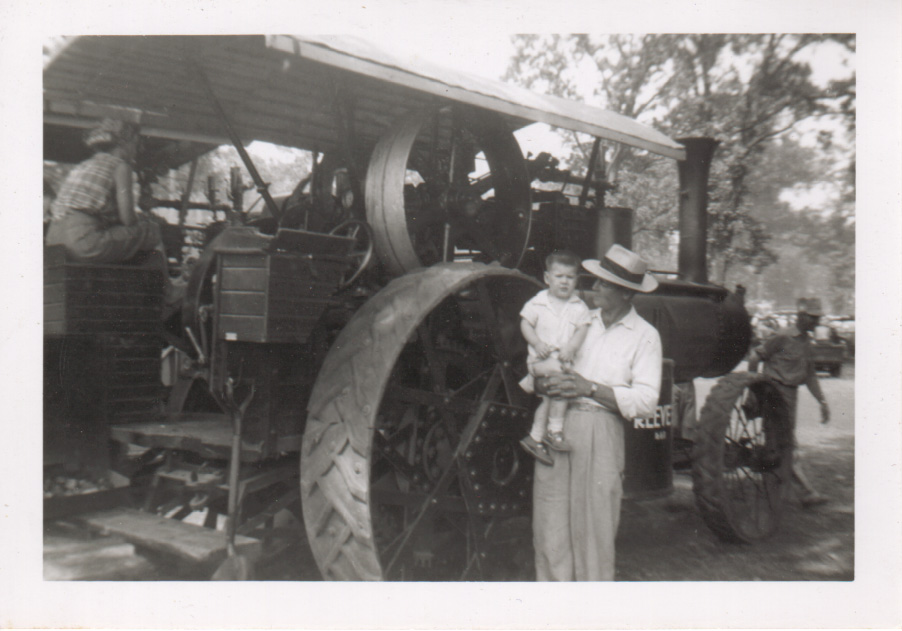
threshing machines. His parents had photographed him standing beside the
Nichols & Shepard Red River Special the last year that Joe had threshed
with his friend Don Akers. Then Joe had bought his first combine, an
Allis–Chalmers, which replaced the threshing machine. Had the family not
attended the Pontiac show each year, Robert might not have been acquainted with
the steam engines that originally supplied the power to the threshers that
separated the wheat and other small grain from the stalks on which the grain
had grown. Joe’s mother’s brother, Uncle Charley, who had died in 1931, had
taught Joe how to run farm steam engines, which Charley had run professionally.
Joe loved to see the steam engines at work again—if only for a weekend in
Pontiac. Robert and Charles looked forward to the annual trip to the threshing
reunion.
The family
scurried around before dawn to get ready to go. Ida packed a picnic lunch of
tomato soup, which was kept warm in thermos bottles. She wrapped a big block of
cheddar cheese with a sharp knife to make cheese sandwiches. Other bottles held
milk and coffee. A loaf of bread and a freshly baked apple pie were carefully
deposited in the basket. Finally, a red blanket was folded and placed on top of
the basket in the trunk of the car. Cookies, as well as other snacks, were
arranged beside Ida where she could monitor them.
When Robert
was five, the family was scurrying around before dawn on a Sunday. Usually, the
family made the trek to Pontiac on a Saturday, but, in that year, Joe had
chosen Sunday so that he would not miss an important Masonic meeting on
Saturday. The week before, Joe had ensured a safe trip by having Glen Bisel put
plenty of air in the spare tire. Glen also made sure that the coolant passages
throughout the engine were not blocked. Even though Joe would not be sitting
anywhere in stopped traffic—and even though his trip was not all that long—it
paid to be sure that the radiator would not overheat. Many drivers carried a
jug of water to refill a radiator whose heat (and, therefore, pressure)
increased beyond the pounds of resistance from the cap. Cars with clouds of
steam streaming out from a raised hood were common sights along roadways. The
drivers of such vehicles were forced to wait until the car cooled down before
refilling the radiator.
In those
days, people dressed up to attend any fair. Accordingly, Joe wore a pair of
pleated slacks, a starched and ironed short-sleeved shirt having a pattern of
light green fish, and a wide-brimmed straw fedora hat. Ida wore a full skirt
with a green and blue floral print and a light blue blouse. The boys put on
their best tan shorts and new shirts with horizontal red-white-and-blue
stripes. When everyone was ready to go, the sun had not yet awakened.
“Are all
the animals fed?” Ida asked Joe.
“Yes,” he
replied. “I gave the cows enough feed to hold them until we get home.”
Joe and Ida
had not bothered to lock the doors to the house. In those times, no one in the
town had a reason to lock a door.
“You did
shut off the light in the kitchen, didn’t you?” Ida asked Joe.
“Yes,” he
answered, “and I made sure the light was off in the boys’ room.”
The car
pulled out of the driveway and headed west.
For the
first many miles, Robert was too excited to nap, but, after a while, he felt
drowsy. His head nodded, and he leaned into a corner of the front seat. He
remembered hearing Ida asking Joe “Are you sure we will make it there?” and Joe
replying “We have a good spare.”
The next
thing Robert knew, the car was parked along a road in the middle of Illinois
and Joe was using a jack to lift the flat tire off the ground. The sun had
arisen. Charles and Ida were standing behind Joe and watching. After Joe had
changed the tire and everyone was back in the car, Ida said, “I hope the spare
will get us there—and back. There won’t be any place open to work on a tire on
Sunday.”
“Glen
looked at the spare and said its patches were good,” Joe reassured Ida.
On went the
car. Just outside Chatsworth, an all-too-familiar bumping sound began. Joe
looked grim.
“What will we
do now?” Ida asked.
“Somebody
in Chatsworth will be able to fix a tire,” Joe said.
The car
limped into town. Joe stopped at a closed service station. A couple walking to
a nearby church noticed the flat.
“Bill can
get you back on the road,” the man said to Joe. “He’ll be at church.”
The couple
went into the church, and, soon enough, another man came out and introduced
himself as Bill.
He opened
the door to the service station. Before long, he had patched both tires. When
Joe took out his wallet to pay Bill, Bill waved his hand and said, “You folks
just go and have a good time at the reunion.”
Joe pulled
into the parking area of the Pontiac 4-H fair at 11:00, giving an hour to look
around before the noon whistle. Ida said she wanted to see the crafts on
display at the ladies’ building while Joe and the boys walked along the line of
engines. Joe and Ida agreed to meet at the car for the picnic lunch at 12:00.
Robert,
Charles, and Joe strode beneath the tall trees that shaded the park. As they
neared the engines, smoke scented with cylinder oil drifted among the
sun-dappled leaves. Robert was a little ahead of Joe and Charles. He wandered
behind an engine and watched as a woman put a shovelful of coal in the firebox.
She was wearing a plaid blouse and jeans. An engineer’s cap was perched
jauntily on the back of her head. She turned around, saw Robert dawdling there,
and asked him, “Do you like steam engines?”
Robert was
delighted that such a great person as a steam engineer would take notice of him.
“Y-yes,” he stammered.
Joe and
Charles stepped up.
“Does he
belong to you?” the woman asked.
“Yes,” Joe
replied. “His name is Robert, and this is Charles. I’m Joe Rhode.”
“I’m Doris
Lindenmier, and this”—she pointed a gloved hand toward the engineer on the
platform of the engine next to hers—“is my husband, Lester.” Pulling the glove
from his right hand, Lester reached down from the platform of his engine to
shake hands with Joe.
“I’m
pleased to meet you both,” Joe said. “We’ve been coming to Pontiac every year
for several years, and I’ve always enjoyed seeing your engines. My uncle was
the engineer for a Reeves outfit in the teens and twenties.”
Doris
nodded smartly. “They’re good engines!” she said.
Both Doris
and Lester ran Reeves engines, which were parked beside one another under the
trees. Lazy billows of smoke rose from their stylishly shaped smokestacks. An
RN, Doris had the additional responsibility of serving as the reunion’s nurse.
Robert felt
a growing fascination for farm steam engines—a fascination that would last
throughout his life.
Doris,
Lester, and Joe talked briefly about Joe’s uncle’s experiences on various
threshing runs, and then Joe said, “I suppose we should be moseying on.”
Doris and
Lester waved as Joe, Charles, and Robert walked farther down the line of steam
engines. They crossed an open area, and Robert was amazed at how quietly a
steam engine could come up behind them so that Joe had to take the boys’ hands
and move to one side, allowing the engine to pass. “Chuff, chuff, chuff,” the
engine sounded, as if it were breathing.
Just before
the noon whistle, Joe brought the boys back to the car. Ida had already spread
the red blanket on the soft grass in the shade of the tree beside the
Chevrolet. Soon, everyone was eating lunch.
Robert did
not care for tomato soup, but, on such a special occasion as getting to go to
the steam engine show, he could tolerate it without complaint. He liked the
cheese sandwich, and he especially liked the apple pie!
The boys
laughed and covered their ears with their hands when the noon whistle took
place. From the area where the steam engines were parked, the madcap whistles
shrieked and tooted in deafening abandon.
Later that
afternoon, Joe and the boys watched as steam threshing was demonstrated.
“Rumble, rumble,” the thresher sounded, as its numerous pulleys and belts came
to life. Men with pitchforks stood atop two wagons piled high with bundles of
wheat. Alternating from one man to the other, their forks lifted sheaves and
dropped them on the feeder with its conveyor belt that brought the bundles to
the chomping knives and the spinning cylinder teeth, which knocked the grain
loose. Eventually, the grain made its way through a loading tube into a wagon
while the chaff and straw blew from a big tube in back onto a straw stack. The
threshing machine received its power from a big belt that crossed over the
flywheel of the steam engine and over the thresher’s main pulley. The two
machines were separated some sixty feet. The crowd of onlookers was so large
that Joe had to thread his way to the front so that Robert and Charles could
get a clear view of the thresher in action. The nicely dressed members of the
crowd smiled and politely made way for the boys to work their way forward.
When the
threshing crew stopped so that the throng could go to the reviewing stands for
the daily parade, Ida joined Joe and the boys, and they sat on the lowest
bleacher. One of Robert’s favorite engines was a Keck–Gonnerman owned by Joe
Weishaupt; it had Donald Duck and Mickey Mouse painted on the bunkers! Ida had
spent her earliest years within a short walk of the Keck–Gonnerman steam engine
factory, so she loved the Kecks exhibited in Pontiac. While Joe often stayed
for the whole parade, on this occasion he said that the family might want to
get an early start on the return trip to Indiana. When almost the last of the
steam engines had rumbled past, Joe, Ida, Charles, and Robert left the stands
and started toward the parking area.
Joe must
have had a premonition. On the way home, the thumping noise returned. Another
flat! As before, Joe slowly changed the tire. Eventually, the Chevrolet pulled
into the driveway and parked. There was still enough light to make it easy to
milk the cows. The next day, Joe bought two new tires.