Robert T. Rhode

Robert T. Rhode
Robert T. Rhode
Showing posts with label Illinois. Show all posts

Saturday, November 4, 2017

My Father Said ... 2


On the cool day following a warm Christmas in 1998, my father, Joseph “Joe” Rhode, entered the house after doing his chores, hung his heavy denim coat on the rack, made a cup of coffee, sat in his customary place at the kitchen table, and began reminiscing by saying Jake St. John owned a side-mounted Nichols & Shepard engine with which Jake ran a sawmill near the Pine Village Cemetery. Jake sold the sawmill to the Cranes, and they powered it with their undermounted Avery steam engine. The Cranes also used their engine on a threshing ring, or run, northwest of Pine Village, Indiana. In driving the engine to the ring, they passed in front of a farm owned by Joe’s grandfather Tom Cobb. In a conversation on December 27th two years earlier, my father said that, “at sundown,” Charlie Allen, Tom’s hired hand, gave permission to Herbert “Herb” Crane and his son Loyd, nicknamed “Jersey” or “Jers,” “to park their Avery steam engine and thresher” on Tom’s farm overnight, “as it was getting dark. Allen smelled a rat and wouldn’t allow the engine to be parked in the barn lot but made them park it farther back, where the ground sloped down to the north.”

Print of Avery Undermounted Steam Engine
In Collection Published in 1954 by Elmer Ritzman
Editor-in-Chief of The Iron-Men Album Magazine

“This might have been in 1928 or ’29,” my father continued, “but Charley Cobb would have moved the engine sooner, so this probably happened in 1930, for Charley died in 1931.” Charley was Tom’s son and was an expert steam engineer. “Charley might have permitted the engine to sit there for a year but not for longer.” Joe said, “ … despite frequent promises to move the engine, the Cranes left it there.” Charley moved it away during the winter after the fall when the engine had been abandoned. My father speculated that the Cranes knew there was something wrong with the engine—so wrong that they were no longer going to fire the boiler.

My father took the big clevis from the Avery as a souvenir. In the 1990s, he presented it to me for use on my Case steam engine. Someone borrowed it when I was exhibiting my engine at the Central States Threshermen’s Reunion in Pontiac, Illinois, and never returned it to me, I am sad to say. I wonder if the new owner of the clevis realizes that it once graced an Avery steam engine.

After disposing of the Avery by leaving it on Tom Cobb’s farm for Charley to collect the scrapping fees, the Cranes “bought a Case [crossmotor] tractor that Joe Williams had purchased to replace his Reeves engine.” Meanwhile, the Cranes moved the sawmill a short distance beside the newer east part of the cemetery. My father continued, “Joe Williams had used the Case tractor ten years, approximately. Joe had died … and Lizzie [his sister] sold the Case tractor to the Cranes.” During our conversation on the 18th of October in 1997, my father said, “Joe Williams had replaced his Reeves engine with an 18–32 Case crossmotor, and [he had] used it to thresh.”

I remember well Jersey’s son Lester, nicknamed “Let,” who worked in the lumber division of the elevator east of town. He was consistently in a good mood and exhibited a great sense of humor.

Sunday, October 15, 2017

Spare Moments at My Folks' Farm 5


Almost every Labor Day Weekend when I was growing up, my parents loaded the 1950 Chevrolet with a picnic basket, blankets, and thermos bottles, and we headed out for Pontiac, Illinois, and the Central States Threshermen’s Reunion, 100+ miles away. The show featured farm steam engines smoking and whistling on the 4-H fairgrounds. One of the principal purposes for such engines was to provide power to threshing machines, which separated wheat and other small grain from the stalks that they had grown upon and which collected the clean grain. As my father’s uncle had trained my father to run such engines long ago, Dad thoroughly enjoyed the nostalgic rally under the massive oaks. My mother had grown up within a short walk of the Keck–Gonnerman steam engine factory; accordingly, she loved the Kecks exhibited in Pontiac. One of them—an 18 HP owned by Joe Weishaupt—had Donald Duck and Mickey Mouse painted on the bunkers. Of course, I loved it!

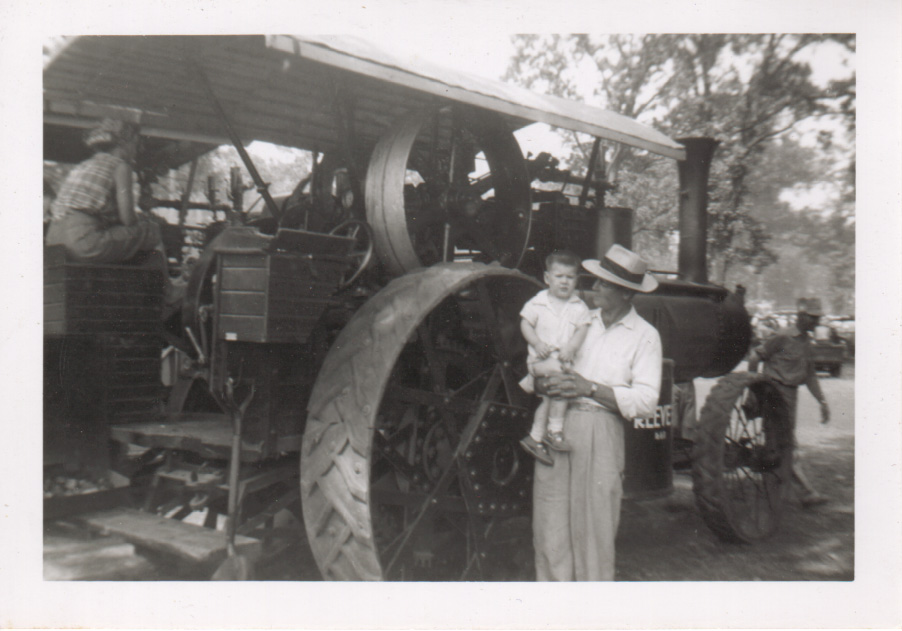
Joseph C. Rhode (1918–1999) with Son
Standing Beside Reeves Steam Engine
Owned by Lindenmier Family
At Central States Threshermen’s Reunion
Pontiac, Illinois, 1953

Even though a boy my age was selling hotdogs, we ate our own dinner (as farmers called the noon meal) when all the engines blew their whistles. I had to hold my hands over my ears because I could feel my eardrums imploding from the sound of so many whistles shrieking at close range. Little did I know that the hotdog boy was John Spalding, with whom I would one day write the nonfiction best seller titled The Steam Tractor Encyclopedia.

Back then, my mother served our dinner beside our car. We were not alone. Up and down the lines of vehicles were other families spreading their blankets and munching sandwiches in the shade of the mighty oak trees. We always ate tomato soup and cheese sandwiches. Not a fan of tomatoes, I looked forward to dessert. Mom made the best pies, cakes, and other baked yummies! It was not at all unusual for me to be presented a quarter of an apple pie that bubbled in the oven just the night before. My parents drank coffee; I drank milk. To this day, I can recall the fun of picnicking at Pontiac!

When we strode around the grounds to watch the steam engines, as well as the Rumely OilPulls, we had to glance over our shoulders to be sure no parading engine was sneaking up on us. At the age of four or five, I wandered behind a 16 HP Reeves engine that was parked and being fired by Doris Lindenmier. She and her husband, Lester, were engineers, and both exhibited Reeves engines. Doris turned around, saw me dawdling there, and asked me, “Do you like steam engines?” I was delighted that such a great person as a steam engineer would take notice of me. That day, she planted the so-called “steam bug” in me, although I was 40 before I could afford to buy a steam engine of my own. I took it to Pontiac, and Doris, still showing engines, invited me to follow her in the parade. As our engines proceeded, my tears of happiness were glistening in the sunshine.

To return to my elementary school days, I will mention that, at one of the shows, I admired the 50 HP Case, then recently restored by Sam Haley. Maybe Sam inspired me to purchase a 65 HP Case many years later. His sons, Jim and John, helped me during the steep uphill learning curve of operating a ten-ton steamer. Eventually, they built new bunkers for my engine.

When I was a kid at the Pontiac shows, legends were forming. Some of them I knew then, some I came to know later, and some I never knew. The legendary engineers included such names as Dan Zehr, Milford Reese, Wilbur Collins, Homer Dixon, J. D. Roberts, Art Erickson, Sylvester Fosdick, Ray Ernst, Herb Beckemyer, Russell Helm, and Henry “Father Time” Lucksinger. I could name many more, and I apologize for not naming them all. The Central States Threshermen’s organization was too big for me to name everyone here.

Typically, on the way to Pontiac or on the return trip, Dad changed a flat tire. In those days, flat tires on trips were expected, even customary. One year, Dad’s spare tire also gave out, and a long delay occurred while Dad searched through a town for a mechanic who could patch tires.

In certain years, Dad bought a model for me in the flea market. I still have my Lesney Models of Yesteryear Allchin traction engine, made in England, which I was given at the 1961 Pontiac show and my American 4-4-0 locomotive, which Dad purchased for me at the 1962 reunion—both in their original boxes. I also have a 1904 Spyker automobile in its box that Dad gave me when we attended the Pioneer Engineers Club show in Rushville, Indiana, in 1963.

The trips to engine shows were highlights of my younger years. I get what Pontiac citizen Bert W. Johnson meant when he said in 1968 that the excitement felt at threshing reunions was like “steam bubbling in your veins.”