Robert T. Rhode

Robert T. Rhode
Robert T. Rhode
Showing posts with label readers. Show all posts

Sunday, February 8, 2015

Why I Plant Cosmos


My first six blog postings were about my friend Mary, and she introduced me to cosmos. I had rented a house, and behind it, the ground sloped down steeply to a creek. “We can plant flowers!” Mary exclaimed with the joy of a gardener who had been forced to spend too many years in apartments. Mary was eager to touch the earth again, and she felt starved for cosmos. “They’re so pretty in a vase,” Mary assured me. So, that spring, Mary brought to my rented house a couple of packets of cosmos seeds.

Judging from the name, I was expecting maybe bright orange flowers like fiery orbs in outer space. I may have been thinking of sunflowers. Little did I know how delicate the stems and petals would be!

A Constellation of Cosmos in My Garden

First, I had to discern the difference between a fledgling cosmos and a weed. I regret to say I probably plucked many of the cosmos seedlings from the soil because I thought they were some other plant that nature had sown and that was not wanted in that location.
   
Eventually, though, I had a good stand of cosmos. Before they bloomed, I was mystified. I could not see what Mary saw in them. Their thin leaves were too thin to be called “leaves,” in my opinion; they looked more like an herb to decorate an entrée. Then pale buttons began to form at the ends of the stems.

One day, I awoke to flowers. Is “gossamer” overused? I hope not, as I want to describe the petals as gossamer. Near the cheerful yellow center, the petals were a hot pink, but the pink cooled toward the petals’ outer ends. Depending on the hour of the day, the angle of the sun, or the presence of clouds, the blooms bore a subtle shade of pale lavender. At other times, they acquired a coral tone.

Mary could not have been more pleased. Out came her scissors, and she began cutting the long stems. I was alarmed. Finally, I said, “Shouldn’t we leave some to enjoy in the garden?” Mary laughed and said, “They’ll keep adding stems all summer.” For the record, I will attest that she cut only enough for a single vase on that first day.

Once Mary had arranged the flowers—which is to say, once she had confined the stems to the vase and had let the flowers arrange themselves—I thought they were ballerinas. They performed with a grand plié and an equally grand jeté! (My cousin Jill, who really was a ballerina, would be proud of my terms!)

Some of the cosmos drooped, others reached up. Some bobbed in the breeze wandering through the kitchen window. Others stood still. They filled their stage with grace. I fully understood why Mary had been so impatient to grow cosmos in my garden. Throughout the season, the plants produced plenty of flowers for Mary’s apartment and my house, too.

Cosmos Like Annual Ballerinas

Ever since Mary helped me appreciate cosmos, I have grown them. Yes, I believe that I have had at least a few cosmos in the flower gardens of every house I have owned. Two years ago, I planted hosts of them within an assortment of flowers forming a border around my vegetable garden, and the elegant blooms danced in vases around my home all summer long. I have come to associate cosmos with the joys of gardening.    

Sunday, February 1, 2015

Why I Planted Tiger Lilies


When I was growing up, my family always drove to Fowler, Indiana, to see the fireworks on the Fourth of July. In the deepening dusk, anticipation grew until the crowd spotted the bobbing pink lights that were the wands the firemen used to ignite the rockets. A cheer went up, and, almost as quickly, so did the opening mortars with a whoosh soon followed by an explosion of vibrant colors.

I connect the spectacular bursts in the night sky with several “firsts” for me. At a very young age, I tasted my first cotton candy at the Fowler fireworks display. Later, I enjoyed my first coffee there. While I have not eaten cotton candy in many, many years, I am sipping a cup of coffee while I type this sentence.

I may have been in seventh grade when I was permitted to drink coffee. My father, mother, brother, and I were awaiting the fireworks. My father poured a cup of coffee from a thermos and handed the cup to my mother, who said, “Are you going to let Robert taste yours?”

“I don’t know. Am I?” my father asked.

“I think he’s old enough,” my mother observed.

My brother, a few years older than I, was already drinking coffee. My father poured a small amount into what was to be his cup and handed it to me. After I blew and blew on the coffee to cool it, I tried it. I loved the nutty flavor! I was hooked from that day forward, but, at first, I was permitted only the occasional cup.  

My Father's Tiger Lilies

I also connect fireworks with tiger lilies, which were my father’s favorite flowers. I think he conferred upon tiger lilies the special status of being his chosen blossoms because they were always in full bloom during his birthday in the third week of July.

The flamboyant lilies seem an incongruous choice of flower for my father, who was soft-spoken, mild, and gentle. I saw him lose his temper only once. It was when a sow broke through a barn door and escaped in the meadow. My father had gone to a lot of trouble to herd the pig into the stall, and, as he knew all too well, making a second attempt to coax the sow into the barn would be an exercise in futility. My father was unaware that I witnessed his anger. He thought he was alone, but I was hiding so as to surprise him when he walked past. Had I not observed his tantrum, I would tell you that he never lost his temper, and I really believe that he almost never did.

My Father Filling the Tank of the Farmall Tractor

Even though tiger lilies are loud and brassy, they are refined, and it is in their refinement that they share a characteristic with my father. A Valedictorian at a time long before any dumbing down of education, my father was intelligent, knowledgeable, and well spoken. He could compose and deliver a speech better than anyone, and such refinement finds an analogy in the tall stalks, exact leaves, and branching flowers of tiger lilies.

Tiger Lilies in Bright Sunlight

If you will make it a point to view such lilies after sundown on an endlessly mellow July evening—and if you will squint—you can imagine the flowers and the unopened buds as the pyrotechnic bursts and streaks of light from fireworks in the night sky.

Tiger Lilies Reminiscent of Fireworks

When my father passed away, a friend urged me to transplant at my home a clump of Dad’s cherished lilies. I did so, and, dependably, they have reached their fullest bloom during the week of my father’s birthday. They serve as a brilliant reminder of his life.

Sunday, January 25, 2015

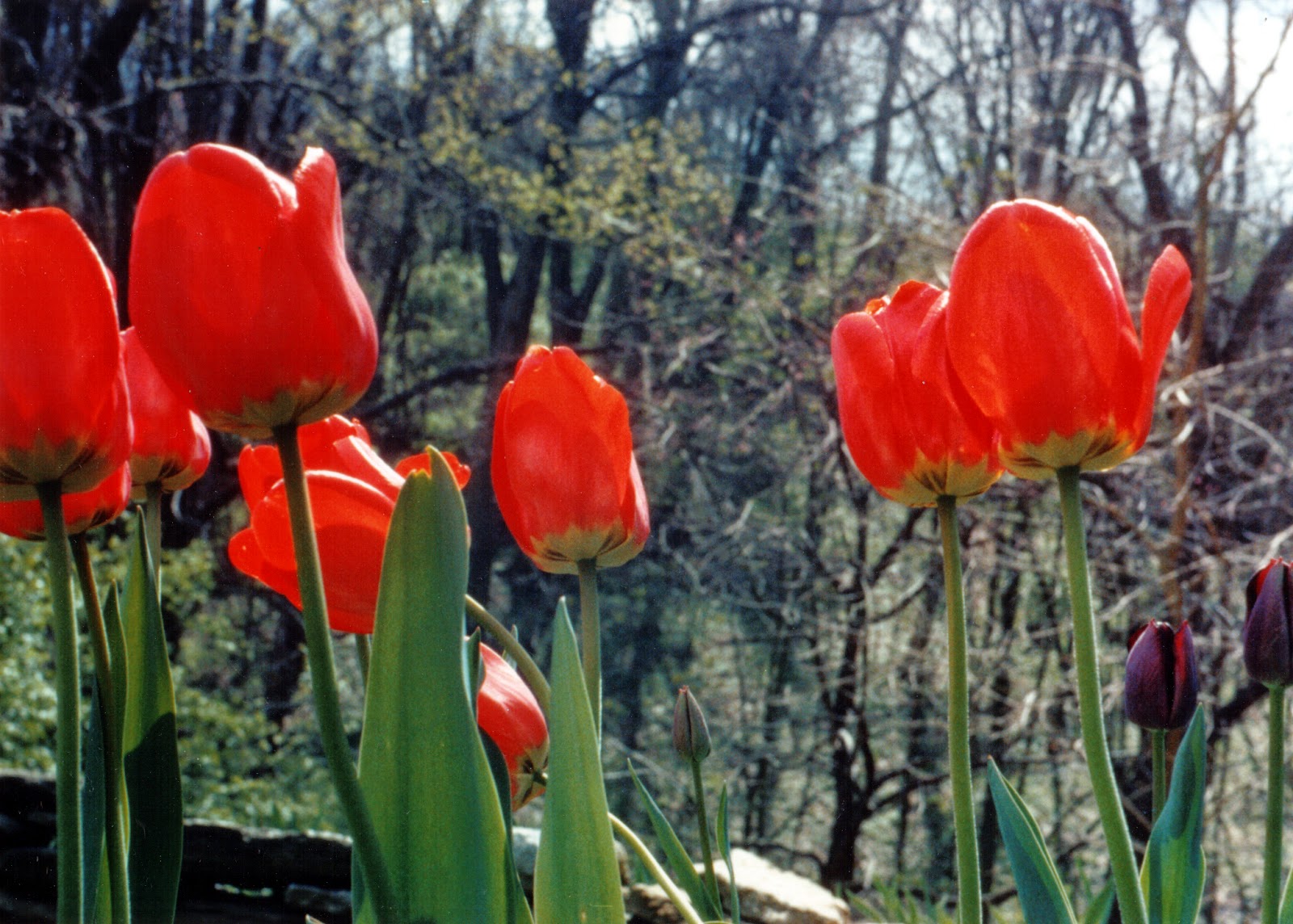
Why I Plant Tulips


For those subscribers to my blog who are experiencing the snow and chilling winds of winter, views of flowers might come as a welcome surprise. One of my cherished memories of my grade school years is walking home from the school, which stood across the road from our house. My route led down our driveway. My mother, who loved blossoms of all kinds, had planted spring bulbs along the graveled path that the 1957 pink two-door Bel Air Chevrolet followed to its parking spot. As the school year was drawing to a close, the sunny afternoons between the April showers found me striding past the profusion of hyacinths, daffodils, and tulips that my mother had crowded into a deep border. The petals nodding in the breeze invited me to slow my steps so as to pay closer attention.

My Tulips Proclaiming the Return of Spring
I observed the unexpected variety of daffodils: tall, short, early, late, long trumpets, compact trumpets, yellow, white, and orange. Naturally, I decided which daffodil was my favorite, and, naturally, I changed my mind the next afternoon.

I bent close to the hyacinths to enjoy their perfume. Such heavenly scent! Closing my eyes and smiling, I caught the delicate fragrance of the tulips. Each kind of tulip possessed its own exquisite bouquet. I don’t expect anyone else to understand this, but I connected the tulip scents with marshmallow Easter egg candies.

To this day, I can see in clear detail my grade-school self standing among the flowers. I am wearing my gray zippered jacket and my blue stocking cap. A book is in my left hand. The daffodils and tulips have diverted me from my walk to the house; I stand among the blossoms. Later, in the hot summer months, this border beside the white board fence will be in dappled shade, but now, in the pastel spring, the leaves to be are merely buds, and the twigs and branches of the trees cast no deep shadows. What a pleasure it is to take the measure of the renewed world! By patiently burying bulbs in cold, blustery November, my mother had planted wonder and delight to flourish when a child’s soul most needed them after the winter months of lessons and tests.

At about the same time, my mother ran the incubator in the enclosed breezeway between the old smokehouse and our home. Chicks and ducklings hatched from the eggs she had patiently candled, turned, and warmed. One of her favorite games was to bring a newly hatched duckling to wake me up for school. I would gradually relinquish the dream world while listening to the peeping of a duckling that Mom was holding close to my ear.

As my mother had taught elementary school before raising a family, she felt a special affinity for teachers and students, and she always invited a few of the grade school teachers to lead their classes across the street to file through our breezeway while learning about incubators and new life fluffing itself among broken shells.

Although I have loved every period of my life, my grade school years occupy a special place in my estimation, and the flowers of the springtime are the hallmarks of my memory.

Wherever I have lived, I have planted bulbs. No matter how tiring it is to prepare the soil bed for the bulbs, to orient them in the right direction, and to cover them with soil that, by November, has begun to turn cool to the hand, I return to the job of planting bulbs. They are the promise of the days and the blooms to come. They are the symbols of my connection to the earth and my potential for surprise. They are the responsibility I have to the arts inspired by nature. By planting bulbs, I acknowledge that I am a steward of the earth and a practitioner of its grace, its elegance, and its charm. When I am treated to the first daffodil blossoms of the spring, I feel the peace of symmetry between plant and planter. 

Sunday, January 18, 2015

Recipe for Snickerdoodles Gone Bad (Last Installment in This Series)


My grandmother and my great aunt baked the best cookies I have ever tasted. Their generation (born before 1900) knew cookies! When I was a boy, one of the towering pleasures of attending Vacation Bible School was to line up in the cool church basement on a hot spring day and to be served two cookies prepared by my grandmother and by other women of approximately her same age. How they discovered the secrets of baking is beyond me, especially when I consider that they learned to bake in hulking iron stoves with ovens fired by wood and without thermometers.

My Grandmother
Who Survived the Flu to Give Birth to My Father

While I would have a difficult time choosing a favorite cookie, I could be forced to declare my grandmother’s sugar cookie the best of the best. All her recipes have been passed down to me. There are dozens of sugar cookie formulations. I have prepared several of them, but they do not produce the cookies I remember. I keep hoping that the special sugar cookies are hiding among the recipes, but I have not yet found them. I am beginning to think that my grandmother was so adept at making them that she needed no recipe.

My Great Aunt Margaret and My Grandmother
Who Learned to Bake Cookies on Iron Stoves

Now and then, a mistake in cooking yields a delectable surprise. I once made a blunder in a snickerdoodle recipe and wound up preferring the result. The ingredients (below) include more butter than the original recipe required. My error occurred when I was doubling the recipe; I doubled the butter and forgot to double the rest of the ingredients. (Yeah, I goofed when multiplying by two. Maybe you can deduce why I did not become a math teacher.) The extra butter causes the cookies to flatten, but they have a melt-in-your-mouth crumb that is delicate and delicious. I call them “Snickerdoodles Gone Bad”!

Ingredients

1½ cup butter softened at room temperature
1½ cups sugar
2 eggs
2¾ cups all-purpose flour
2 tsp cream of tartar
1 tsp baking soda
¼ tsp salt
2 tsp cinnamon and 2 Tbsp sugar combined

Directions

Mix at medium speed in a large bowl the butter, sugar, and eggs until light and fluffy (at least 2 minutes). Combine in a separate bowl the flour, cream of tartar, baking soda, and salt. Add these to the creamed mixture and blend them well. Refrigerate the dough at least 30 minutes. Preheat the oven to 375° and combine the cinnamon and sugar. Shape the dough into 2 balls and roll them in the cinnamon and sugar. Bake the cookies for 12–15 minutes on an ungreased cookie sheet. The tops of the cookies will puff up at first then flatten. Creases will form, and the edges will brown slightly.