Robert T. Rhode

Robert T. Rhode
Robert T. Rhode
Showing posts with label flower. Show all posts

Sunday, August 23, 2015

Reflections on Wildflowers 1


When I looked forward to retirement, I thought about identifying the wildflowers around my home. I pictured myself, guidebook in hand, stooping low over tiny petals and learning the names of the plants surrounding me. Now that I am retired and have honored my vow, I am ready to report that naming wildflowers has been even more fun than I imagined it would be!

Common Spring Beauty, Photograph by Wild Flower Preservation Society
In Norman Taylor’s Wild Flower Gardening (D. Van Nostrand, 1955)

In May, I found Spring Beauty around the trunks of two of my oldest and largest trees. I had noted the white blossoms with touches of pink when I first moved to the property over a dozen years ago, and I had always avoided mowing the areas where the flowers bloomed. Spring Beauty is aptly named. I am embarrassed to admit that, during the years when I was working, I felt too rushed to take the time to identify the small blossoms that I so admired.

In the midst of the grass in the broad yards fronting the barn, the tiniest spikes of white flowers opened above a plant creeping outward through the grass. I found that Common Speedwell has faintly bluish stripes embroidering the petals. It purportedly has astringent and diuretic properties. Hmmm. I doubt that I will sample the plant to see.

I almost overlooked Shepherd’s Purse, which grew in my beds of iris. Its many heart-shaped mittens waved at me. Oddly enough, when I knew its name, I no longer considered it a weed. I left it where it was with as much right to be a flower as the iris that I had planted.

The stylish Garlic Mustard put forth white blossoms on my hill of walnut trees and along my creek. Since 1868, the plant has spread westward from New York.

Reminiscent of the Queen Anne’s Lace that would appear much later in the season, Sweet Cicely ornamented the shady bowers at creek’s edge.

Ground Ivy (also known as Creeping Charlie) bloomed everywhere. Its violet-blue flowers painted large sections of my yard.

By identifying the wildflowers around my house, I began to live more consciously than before. I felt a kinship to the plants. While I recognized that their task is to survive, their blooms appealed to my artistic sense. They completed pictures delighting the eye with their harmony. The changing display of blossoms satisfied me as correct for spring and for summer as separate seasons, each with its own aesthetic expression in the part of the world where I am fortunate to reside. I realized that I, too, am living through seasons—that I, too, express myself differently in summer than in spring, in autumn than in summer. Every season settles into its own responsibilities and pleasures.

Sunday, July 5, 2015

My Summer in a Garden: Harvesting Days (Last Installment in This Series)


The earliest origins of the word harvest seem obscure to me. In my estimation, the more logical argument is that the word comes from words of long ago that meant to pluck, as in plucking fruit. The less obvious line of linguistic reasoning is that harvest is related to harrow, a noun or a verb referring to the stirring of the soil prior to planting. My thinking is that harrowing and harvesting are at such opposite ends of the gardening venture that they must not be related. The word harrowing, though, can mean a distressing experience that deeply stirs the emotions. Given the problems I encountered with this year’s garden, I can certainly describe my gardening experience as harrowing.

Plucking the fruits of my labor is much more positive, and I want to focus on that meaning of harvesting. With more rain than anyone knew what to do with, my garden lurched into productivity. It is only the beginning of July, yet almost everything in my garden is ready to be harvested.

A Wagonload of Squash from My Garden

I am clipping vibrant flowers for bouquets. I must bring in my beets, prepare a few for canning, and eat the rest. Yum! My carrots are at the delightfully tender stage. Potatoes are nearing the day when they should be dug. Beans are setting on, and I have a predictable surplus of squash, which I have been devouring with gusto and a little salt. While the tomato plants are tall, bushy, and green, they need hot days and dry air to be effective. I am already gathering onions, and it will not be long before the entire crop should be dried on my screened-in porch prior to tying the golden bulbs in bunches and hanging them from nails on the walls of my solarium. (See my blog entitled “Why I Plant Onions” [March 22].) I look forward to snipping off onions as needed in my cooking.

So I feel truly civilized. I have gardened. I have grown my own food. I am harvesting my own vegetables. I am cultured, and I am literary. The word culture arises from an old word for plow (or plough, if you prefer); as I have frequently plowed my garden, the earth and I (one of its stewards) have become cultured. By virtue of the fact that literature arises from culture and I have blogged about my garden, I hope I have been literary. I have closed the circle: plowing, planting, weeding, hoeing, harvesting, cooking, eating, reading, writing, culturing (plowing). In this way, agriculture can be seen as the preparation for enlightenment, a higher circle, if you will. In the same way that the blade of my hoe became polished during frequent use, the practice of tending to my garden has polished me.

I come away from the experience with respect for the cycles of nature and with joy for this chance to breathe the air, work the ground, and pay attention to the songs of warblers, the wings of butterflies, and the destinies of clouds. When I taste the fresh beets, I feel at one with the planet hosting my little time here.

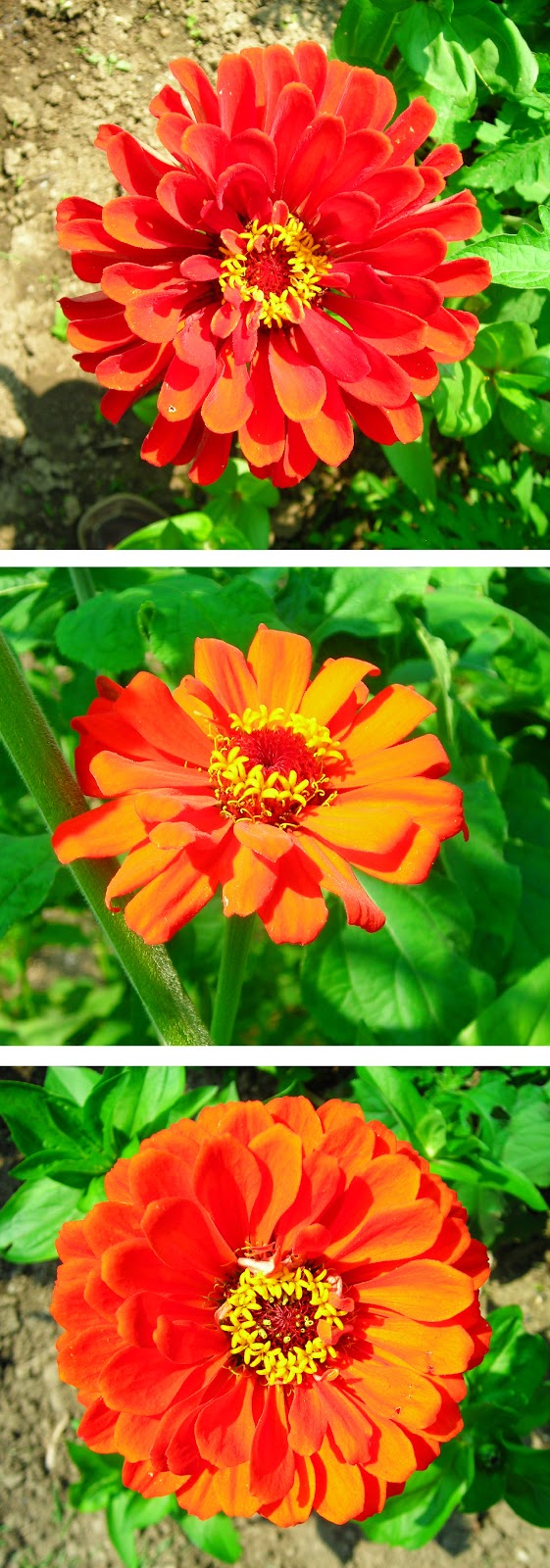
My Jubilant Zinnias
 
Was my garden worth the trouble? I have no doubt that the answer is yes. When I was in graduate school, I came to value—to crave—the literary life: that is, bringing together literature and my life. I felt that one of the greatest results to be gained from diligently studying great works of literary art was to live a life of expanded possibilities. My vegetables and flowers are filling my senses, and literature is shaping my understanding and appreciation of what I am experiencing. This summer, my garden is helping me confirm that literature amplifies existence.   

Saturday, June 27, 2015

My Summer in a Garden: Weeding 3.0


Abundant rain kept me out of my garden. After the wet spell, I strolled out to take a proud view of my neat rows. I saw a carpet of thick, tall weeds carpeting the ground. “I must have been mistaken,” I thought. “I must have imagined that I weeded and hoed this garden a week ago. It could not have been this garden that I so carefully tended. Maybe I accidentally weeded and hoed someone else’s garden.”

Garden Coming Along on June 21st

I took my trusty hoe and began. The weeds were worse than they were before. Fortunately, the rain had made the ground easy to work. It was no trouble to pull the largest weeds, root and all. There were just so many of them! Also, the hoe cut through the upper surface of the ground just enough to clip the stems from the roots of the weeds too small to pull. The summer solstice had come and gone, and the heat was much higher than it had been even a week earlier. I follow the practice of my father and the old-time farmers: I wear jeans, a long-sleeve shirt, gloves, and a broad-brimmed hat. I prefer not to be sunburned, and the long sleeves keep me less hot than I would be otherwise. Even with my protective clothing, I soon felt perspiration, which soaked through my shirt. Before long, even my jeans were damp!

Garden After Third Massive Weeding

I struck the hoe over and over against tough roots. I bent low over rows to pull huge pigweeds from amid the potatoes. I could not believe that, for the third time this year, I was involved in a monstrous weeding, as if the previous two weedings had been for nothing.

Next year, before I order seeds, I will read my blogs. Maybe I will become a regular customer at the farmer’s market and will skip gardening. What joy is there in repeating exactly the same hard work of a week ago?

The fact that many of my seeds had not sprouted in the first place was haunting me now. Large gaps were not shaded by the leaves of vegetables and had to be hoed smooth. Not far from where I live is a perfect garden of about the same size as mine. It stands so near the road that I am forced to look upon it. The rows are as straight as a ruler, the plants are spaced exactly alike down the rows, the stakes have the same height throughout and do not lean, and the weeds—well, there are none. What gardener has the patience and the good luck to have a garden like that? I would ask the owner if I could take a picture to post online, but I fear that the obsessive compulsive individual might rightly ask to see my garden. So everyone will have to imagine how faultless and immaculate that other garden is.

The First Flowers in My Garden

My garden is what a garden is meant to be: haphazard, uneven, inexact, and overgrown in spots. Of course, the previous sentence is only a literary stunt intended to sound true but a cheap alibi nonetheless. I wish my rows were as satisfactory as those of my neighbor, but, before I covet my neighbor’s cucumber, I will content myself by saying that, after I hoed my last weed, I harvested three fat zucchini that will send me into an ecstatic state of mind at my dinner table. As I carried them to the house, I almost forgot my aching back.

Sunday, March 1, 2015

Why I Plant the Iris, Poppy, Daylily, Coneflower, and Naked Lady (Last Installment in This Series)


Five Spectacular Easy-Care Flowers

If you would like to grow low-maintenance flowers with spectacular displays from late spring through early fall, here are five of my favorites.

1. You can’t go wrong with the iris, named for the Greek goddess of the rainbow. When I was growing up, my father clipped the long stems of the iris to place on graves on Memorial Day. In those times, no one resorted to artificial flowers. The iris and the peony were the flowers of choice in the cemeteries that I recall. Most likely, the iris, not the lily, is the basis of the fleur de lis, the well-known symbol. I turn to heraldica.org for this explanation: “It is a stylized flower, but which flower? It looks more like an iris than a lily. Moreover, lilies are never yellow in the wild, whereas some irises are. Could there have been confusion between the two flowers? The word ‘lis’ appears in French in 1150, whereas the word ‘iris’ designates the flower in the 13th c. The term ‘fleur de lis’ in the heraldic sense is attested in 1225. … a hypothesis ventured in the 17th c. sounds very plausible to me. One species of wild iris, the Iris pseudacorus, yellow flag in English, is yellow and grows in marshes (cf. the azure field, for water). Its name in German is Lieschblume (also gelbe Schwertlilie), but Liesch was also spelled Lies and Leys in the Middle Ages. It is easy to imagine that, in Northern France, the Lieschblume would have been called ‘fleur-de-lis.’ This would explain the name and the formal origin of the design, as a stylized yellow flag. There is a fanciful legend about Clovis which links the yellow flag explicitly with the French coat of arms.”

Yellow Iris Gracing My Flower Garden
2. Poppies can take center stage when the iris blooms are fading. I have always thought of poppy petals as crepe paper, maybe because, when I was little, flowers made from the paper were distributed in my church on Mother’s Day. Anyone whose mother was living wore a red flower, and anyone whose mother had passed away wore a white flower. While the simple flowers were supposed to be carnations, I mistook them for poppies. Whenever I see poppies, I still believe that their petals might feel like crepe paper.

Poppies Providing Bursts of Bright Color
3. After the poppies have dropped their petals, the daylilies can have their day in the sun. Actually, they can have months in the sun! When you plant different kinds of daylilies, you can ensure fresh blooms throughout the summer. Some varieties will keep flowering for four or five weeks. Others will bloom for one cycle, rest for a while, and bloom again. New blossoms open each morning to replace those that had gladdened the previous afternoon.

Daylilies in Stately Profusion Along My Driveway
4. For a thick planting of fairly tall blooms that continue throughout the midsummer, coneflowers are ideal. I like seeing the multiplicity of butterflies that visit the display, but few sights are more aesthetically pleasing than that of an orange monarch butterfly perched on a purple coneflower with its velvety orange center! Coneflowers require almost no care, other than watering during dry spells.

Coneflowers in a Thick Display
 
Velvety Orange Centers of Coneflowers
 
Purple Petals That Butterflies Find Irresistible
5. Finally, we have the shockingly nicknamed “naked ladies”! They are really the belladonna lily, but, under the circumstances, who can remember their real name? The green leaves of their springtime modesty die down by midsummer. In late summer, up leap naked flower stalks, and large pink trumpets unfold! “Amaryllis belladonna” was the name (Amaryllis) and description (Italian bella donna, or “pretty woman”) of an alluring rustic woman in Greek myth. The naked ladies are, thus, a form of amaryllis—and a toxic form, as suggested by the horticultural meaning of belladonna. If for some unknown reason you were considering the possibility of nibbling these flowers, be warned not to ingest naked ladies, for they are mildly poisonous. The sap of the plant causes blistering rashes. It is advisable to wear gloves during fall plantings of the big bulbs.

Naked Ladies with No Reason to Be Ashamed