Robert T. Rhode

Robert T. Rhode
Robert T. Rhode
Showing posts with label zinnia. Show all posts

Sunday, July 10, 2016

Gardening 5


“It was the most wonderful garden in all the world because the flowers did exactly what they pleased. They seeded down and came up and seeded down again and ran into each other’s arms and on past and scattered everywhere, and all the vines ran sprawling over the ground or climbed trees or ran on top of the fence; and all the bulbs spread and grew in clusters, and everything was wild and free.”

—The Magic Garden by Gene Stratton–Porter

A year ago, a bird planted a morning glory seed in the corner of my vegetable garden. I did not recognize the plant as either a vegetable or a weed, and I let it grow. That summer, dark blue blossoms of prodigious size decorated vines that truly “ran sprawling over the ground … wild and free.” This summer, dozens of morning glory seedlings have sprouted in that same corner. I have transplanted several around the lampposts by the street, and I have permitted many more to grow among my vegetables and to do “exactly what they pleased.” Others I have had to plow out, so as to have some semblance of order.

Garden After Rain on the 5th of June

“Oh! Blessed rage for order, Pale Ramon,” I remember studying in college for the first time. How often since those serene days as an undergraduate at Indiana University have I returned to Wallace Stevens’ poem entitled “The Idea of Order at Key West,” teasing out meaning after meaning! Now that I have retired after a long career teaching early American literature at Northern Kentucky University, I am prepared to leave Wallace’s meanings alone. In the same way that Wallace’s order roars in and drifts out like waves on a beach, order in my garden is only one of two opposite manifestations of something larger. By continuous cultivating, I impose order in the form of rows, but, by running “into each other’s arms” and beyond, the flowers bring disorder. Now, what is the name for the synthesis of order and disorder? Call it Beauty, for that is its effect! Or call it Glory, to honor the flower! Or call it nothing at all and relish the feeling that order and disorder are finally the same in a summertime garden.

Another View After the June 5th Rain

The squash seeds that I planted at neat intervals have become jungle plants recognizing no boundaries. The beans have crisscrossed their branches until I am unable to find all the slender pods concealed in rich profusion among the leaves. The heavy heads of the sunflowers droop and bob on springy stalks in and out of the floral border. Throughout the sunlit hours, birds and butterflies flit among the sunflowers, tithonia, and cosmos in kaleidoscopic color.

Sunflower Bobbing in the Border of My Garden on June 29th

At Pontiac, Illinois, many years ago, a deep orange sunset made silhouettes at the Central States Threshermen’s Reunion. Brothers Jim and John Haley had been helping me show my farm steam engine and were teaching me how to shut down the machine for the evening. Jim said, “We’ve had about as much fun as we can stand for one day.” His expression is well suited to gardening, too. Every summer, the garden that I call mine gives me more happiness than I can contain.   

Sunday, June 26, 2016

Gardening 3


“Apart from Thee we plant in vain
        The root and sow the seed;
Thy early and Thy later rain,
        Thy sun and dew we need.”

      —“Garden: A Hymn for the American Horticultural Society, 1882” by John Greenleaf Whittier, the Quaker Poet

What my garden did not need was a freeze on the morning of the 16th of May. My poor potatoes and bush beans! Their leaves turned a dark, ugly green and folded down around their stems like collapsed umbrellas. Only time will tell if the potatoes can recover.

My Beans and Potatoes After a Freeze on May 16th

Just when I was allowing myself to think that, this year, my garden will be the best I have had in the past several years, Mother Nature may have had other ideas.

Before dawn, I had trained my flashlight on my outdoor thermometer and had seen that the temperature had dropped to 30° Fahrenheit. In the stillness of that hour, I felt alarm. What would happen to the young, tender plants? Would the temperature at ground level be a few degrees higher? Would there be no killing frost? I hoped for a good outcome.

At sunrise, frost blanketed my lawn. A few hours later, I visited my garden, and my heart sank. I grew up on a farm. Accordingly, I am generally prepared to accept acts of God that can menace livestock or damage crops. Even so, I felt sad. As I stood there, observing my poor beans and potatoes, I felt sad for them, not so much for me. For an instant, I even questioned whether I could have covered the rows on the previous evening. Perhaps I could have spared the plants this agony. Then I realized that I would have needed lots of sheets to cover four rows. I had protected a recently moved peony with a large cardboard box, but I could not have defended my potatoes and beans from the cold.

Beans Replanted on May 23rd

Suddenly, I remembered it. Was it an old saying, or was it simply advice from a neighbor? It went something like this: “Don’t plant your garden until after the 15th of May.” Naturally, some plants can withstand a frost. As far as I can tell, my lettuce, beets, and onions have not suffered from the low temperature. For that matter, my border of flowers looks normal to me. The fact that the frost came on the 16th lends the advice the ring of truth, particularly for beans and potatoes.

I replanted the beans on the 23rd. Then I awaited the future. Will the potatoes continue to serve their stems until fresh foliage opens to the sun? As Whittier wrote, “we plant in vain” without “Thy sun”—and without Thy warmth, he might have added.


Sunday, June 19, 2016

Gardening 2


“The influence of her taste was seen also in the family garden, where the ornamental began to mingle with the useful; whole rows of fiery marigolds and splendid hollyhocks bordered the cabbage beds, and gigantic sunflowers lolled their broad, jolly faces over the fences, seeming to ogle most affectionately the passers-by.”

     —“Wolfert Webber, Or Golden Dreams,” in Tales of a Traveler by Washington Irving

A few years ago, I had the happy inspiration to surround my vegetable garden with a floral border mixing “fiery marigolds” and “gigantic sunflowers.” My thought was to cut as many bouquets as I might like, and I have gathered armloads of blossoms from the prolific display of flowers surrounding my beans and squash. Even so, I have experienced an irrational reluctance to turn to my borders for blooms. The profusion of petals is so spectacular en masse and such an invitation to butterflies and birds that I am hesitant to claim any zinnias or cosmos for my kitchen or living room. To demur is silly. After all, at the end of the season, the flowers will have gone to seed and, in the spring, their stalks will be plowed under. I might as well remain true to my vision and cut flowers at will.

My Garden on May 12, 2016

Unlike the character in Irving’s tale, I have no cabbages for my flowers to accompany. While I like cooked cabbage—especially on St. Patrick’s Day—I seldom have enough use for cabbage to justify growing any in my garden. When I was growing up, my mother planted rows of cabbages. For exhibits at the annual 4-H fair, we walked up and down in search of the largest cabbage, a heavy one with great waxy leaves spread so wide that it was all I could do to hold it in front of me and to lug it back to the house. In retrospect, I wonder what my mother did with all that cabbage. When I was very young, she made sauerkraut in ancient crocks that huddled in the darkness of a cellar beneath our smokehouse, but, by the time I participated in the gardening projects at the county fair, she no longer made kraut. Our family ate plenty of cooked cabbage, but we could not possibly have consumed as much as my mother grew. A cabbage conundrum!

Sunflowers I have in abundance! Small and large, yellow and red, my sunflowers may not “ogle most affectionately the passers-by,” but they serve as banquets for birds and squirrels. At precisely the moment when their diamond-pattern seed cushions become ready for shelling, the birds come to help themselves to the bounty. In only a day or two, the seeds are pecked loose. The birds are not tidy. They drop many seeds on the ground. The squirrels do not pause to thank their feathered compatriots; rather, they busily comb the ground to scavenge every seed abandoned by the birds.

Alas! I have no hollyhocks. I admire them in the distant yards of neighbors, but I grow none of my own. Up close, they are so dry, dusty, insect-ridden, and full of spiders that I am loath to plant any.

My borders feature the delicately arching cosmos, the frankly sturdy marigold, the utterly dependable zinnia, and the wonderfully robust tithonia in rainbows of hue and tint. Going to the garden to fetch a batch of beans is a treat for the eyes!       

Sunday, July 5, 2015

My Summer in a Garden: Harvesting Days (Last Installment in This Series)


The earliest origins of the word harvest seem obscure to me. In my estimation, the more logical argument is that the word comes from words of long ago that meant to pluck, as in plucking fruit. The less obvious line of linguistic reasoning is that harvest is related to harrow, a noun or a verb referring to the stirring of the soil prior to planting. My thinking is that harrowing and harvesting are at such opposite ends of the gardening venture that they must not be related. The word harrowing, though, can mean a distressing experience that deeply stirs the emotions. Given the problems I encountered with this year’s garden, I can certainly describe my gardening experience as harrowing.

Plucking the fruits of my labor is much more positive, and I want to focus on that meaning of harvesting. With more rain than anyone knew what to do with, my garden lurched into productivity. It is only the beginning of July, yet almost everything in my garden is ready to be harvested.

A Wagonload of Squash from My Garden

I am clipping vibrant flowers for bouquets. I must bring in my beets, prepare a few for canning, and eat the rest. Yum! My carrots are at the delightfully tender stage. Potatoes are nearing the day when they should be dug. Beans are setting on, and I have a predictable surplus of squash, which I have been devouring with gusto and a little salt. While the tomato plants are tall, bushy, and green, they need hot days and dry air to be effective. I am already gathering onions, and it will not be long before the entire crop should be dried on my screened-in porch prior to tying the golden bulbs in bunches and hanging them from nails on the walls of my solarium. (See my blog entitled “Why I Plant Onions” [March 22].) I look forward to snipping off onions as needed in my cooking.

So I feel truly civilized. I have gardened. I have grown my own food. I am harvesting my own vegetables. I am cultured, and I am literary. The word culture arises from an old word for plow (or plough, if you prefer); as I have frequently plowed my garden, the earth and I (one of its stewards) have become cultured. By virtue of the fact that literature arises from culture and I have blogged about my garden, I hope I have been literary. I have closed the circle: plowing, planting, weeding, hoeing, harvesting, cooking, eating, reading, writing, culturing (plowing). In this way, agriculture can be seen as the preparation for enlightenment, a higher circle, if you will. In the same way that the blade of my hoe became polished during frequent use, the practice of tending to my garden has polished me.

I come away from the experience with respect for the cycles of nature and with joy for this chance to breathe the air, work the ground, and pay attention to the songs of warblers, the wings of butterflies, and the destinies of clouds. When I taste the fresh beets, I feel at one with the planet hosting my little time here.

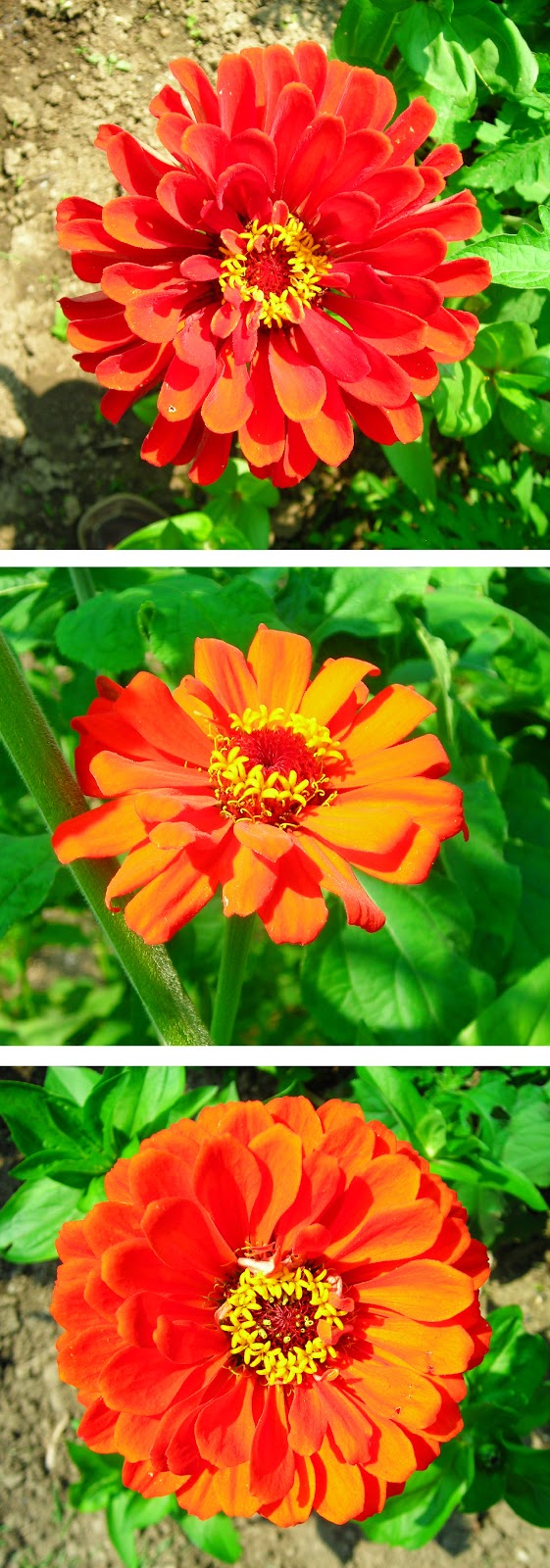
My Jubilant Zinnias
 
Was my garden worth the trouble? I have no doubt that the answer is yes. When I was in graduate school, I came to value—to crave—the literary life: that is, bringing together literature and my life. I felt that one of the greatest results to be gained from diligently studying great works of literary art was to live a life of expanded possibilities. My vegetables and flowers are filling my senses, and literature is shaping my understanding and appreciation of what I am experiencing. This summer, my garden is helping me confirm that literature amplifies existence.