Robert T. Rhode

Robert T. Rhode
Robert T. Rhode
Showing posts with label tomatoes. Show all posts

Sunday, July 5, 2015

My Summer in a Garden: Harvesting Days (Last Installment in This Series)


The earliest origins of the word harvest seem obscure to me. In my estimation, the more logical argument is that the word comes from words of long ago that meant to pluck, as in plucking fruit. The less obvious line of linguistic reasoning is that harvest is related to harrow, a noun or a verb referring to the stirring of the soil prior to planting. My thinking is that harrowing and harvesting are at such opposite ends of the gardening venture that they must not be related. The word harrowing, though, can mean a distressing experience that deeply stirs the emotions. Given the problems I encountered with this year’s garden, I can certainly describe my gardening experience as harrowing.

Plucking the fruits of my labor is much more positive, and I want to focus on that meaning of harvesting. With more rain than anyone knew what to do with, my garden lurched into productivity. It is only the beginning of July, yet almost everything in my garden is ready to be harvested.

A Wagonload of Squash from My Garden

I am clipping vibrant flowers for bouquets. I must bring in my beets, prepare a few for canning, and eat the rest. Yum! My carrots are at the delightfully tender stage. Potatoes are nearing the day when they should be dug. Beans are setting on, and I have a predictable surplus of squash, which I have been devouring with gusto and a little salt. While the tomato plants are tall, bushy, and green, they need hot days and dry air to be effective. I am already gathering onions, and it will not be long before the entire crop should be dried on my screened-in porch prior to tying the golden bulbs in bunches and hanging them from nails on the walls of my solarium. (See my blog entitled “Why I Plant Onions” [March 22].) I look forward to snipping off onions as needed in my cooking.

So I feel truly civilized. I have gardened. I have grown my own food. I am harvesting my own vegetables. I am cultured, and I am literary. The word culture arises from an old word for plow (or plough, if you prefer); as I have frequently plowed my garden, the earth and I (one of its stewards) have become cultured. By virtue of the fact that literature arises from culture and I have blogged about my garden, I hope I have been literary. I have closed the circle: plowing, planting, weeding, hoeing, harvesting, cooking, eating, reading, writing, culturing (plowing). In this way, agriculture can be seen as the preparation for enlightenment, a higher circle, if you will. In the same way that the blade of my hoe became polished during frequent use, the practice of tending to my garden has polished me.

I come away from the experience with respect for the cycles of nature and with joy for this chance to breathe the air, work the ground, and pay attention to the songs of warblers, the wings of butterflies, and the destinies of clouds. When I taste the fresh beets, I feel at one with the planet hosting my little time here.
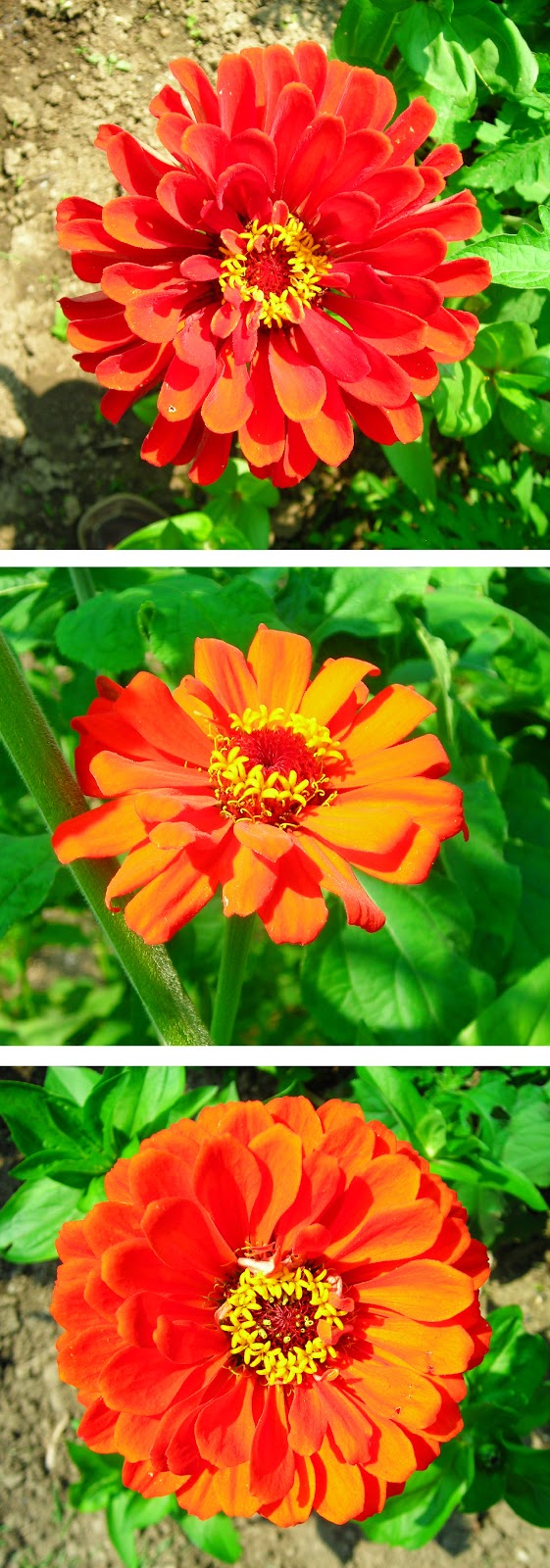
My Jubilant Zinnias
 
Was my garden worth the trouble? I have no doubt that the answer is yes. When I was in graduate school, I came to value—to crave—the literary life: that is, bringing together literature and my life. I felt that one of the greatest results to be gained from diligently studying great works of literary art was to live a life of expanded possibilities. My vegetables and flowers are filling my senses, and literature is shaping my understanding and appreciation of what I am experiencing. This summer, my garden is helping me confirm that literature amplifies existence.   

Saturday, June 27, 2015

My Summer in a Garden: Weeding 3.0


Abundant rain kept me out of my garden. After the wet spell, I strolled out to take a proud view of my neat rows. I saw a carpet of thick, tall weeds carpeting the ground. “I must have been mistaken,” I thought. “I must have imagined that I weeded and hoed this garden a week ago. It could not have been this garden that I so carefully tended. Maybe I accidentally weeded and hoed someone else’s garden.”

Garden Coming Along on June 21st

I took my trusty hoe and began. The weeds were worse than they were before. Fortunately, the rain had made the ground easy to work. It was no trouble to pull the largest weeds, root and all. There were just so many of them! Also, the hoe cut through the upper surface of the ground just enough to clip the stems from the roots of the weeds too small to pull. The summer solstice had come and gone, and the heat was much higher than it had been even a week earlier. I follow the practice of my father and the old-time farmers: I wear jeans, a long-sleeve shirt, gloves, and a broad-brimmed hat. I prefer not to be sunburned, and the long sleeves keep me less hot than I would be otherwise. Even with my protective clothing, I soon felt perspiration, which soaked through my shirt. Before long, even my jeans were damp!

Garden After Third Massive Weeding

I struck the hoe over and over against tough roots. I bent low over rows to pull huge pigweeds from amid the potatoes. I could not believe that, for the third time this year, I was involved in a monstrous weeding, as if the previous two weedings had been for nothing.

Next year, before I order seeds, I will read my blogs. Maybe I will become a regular customer at the farmer’s market and will skip gardening. What joy is there in repeating exactly the same hard work of a week ago?

The fact that many of my seeds had not sprouted in the first place was haunting me now. Large gaps were not shaded by the leaves of vegetables and had to be hoed smooth. Not far from where I live is a perfect garden of about the same size as mine. It stands so near the road that I am forced to look upon it. The rows are as straight as a ruler, the plants are spaced exactly alike down the rows, the stakes have the same height throughout and do not lean, and the weeds—well, there are none. What gardener has the patience and the good luck to have a garden like that? I would ask the owner if I could take a picture to post online, but I fear that the obsessive compulsive individual might rightly ask to see my garden. So everyone will have to imagine how faultless and immaculate that other garden is.

The First Flowers in My Garden

My garden is what a garden is meant to be: haphazard, uneven, inexact, and overgrown in spots. Of course, the previous sentence is only a literary stunt intended to sound true but a cheap alibi nonetheless. I wish my rows were as satisfactory as those of my neighbor, but, before I covet my neighbor’s cucumber, I will content myself by saying that, after I hoed my last weed, I harvested three fat zucchini that will send me into an ecstatic state of mind at my dinner table. As I carried them to the house, I almost forgot my aching back.

Sunday, December 28, 2014

Recipe for Dinner in a Dish


In the farming region where I grew up, a general financial downturn ran throughout the 1920s and continued as the Great Depression beginning in 1930. The severe economic conditions rapidly worsened, slowly diminished in the last years of the 1930s, and ended more or less in the early 1940s. Extreme heat in 1934 and again in 1936 threatened to make farming a losing proposition. My father said that, in 1934, there were only a few glimmers of hope that the economic slump might end but that, by the late 1930s, the country’s overall financial situation had become noticeably less dire. During the era, even farm families that could grow much of their food were mindful of the cost. Recipes for inexpensive meals were widely shared.


My Father with Horses Named Togo and Maud in April of 1930
The Middle of a Long Economic Depression in Rural Indiana
One such recipe, called “dinner in a dish,” was the contribution of Elsie Dowden, who lived in my hometown but who grew up in Bedford. If you like recipes that combine hamburger with other ingredients, you will enjoy Elsie’s dinner in a dish!

I have used Panko instead of bread crumbs with good results, but, if you prefer a larger crumb, dry several slices of bread on trays in a warm kitchen for a day until the bread crumbles into large morsels.

My mother referred to the recipe’s green peppers as “mangoes.” In the 1700s, fruit, such as the mango, and vegetables, such as the green pepper, were pickled to preserve them. People began to call any pickled fruit or vegetable a “mango.” The generic term stuck for the green pepper and was in widespread use as late as my mother’s generation.


Rev. Lowell Morris and Mrs. Morris on July 29, 1937
At the Parsonage in Westville, Indiana
Before They Moved to My Hometown
Near the End of the Great Depression
If you want to reduce the salt in your diet, you can put only 1 tsp of salt in the mixture without a significant loss of saltiness; in fact, I tend to find the recipe’s salt level a bit too much. I have wondered if people who lived through the Great Depression were so accustomed to preserving meat in salt that they felt they needed lots of salt in a hamburger dish.

The directions warn against accidental scrambling of the eggs when adding them to ingredients that have just come from a hot skillet. You don’t have to worry excessively about scrambling the eggs; even if your mixture is too hot, the eggs won’t entirely scramble, and you won’t notice the scrambling.

Incidentally, to “dot with butter” means to shave some cold butter here and there on top of the bread crumbs to flavor them and brown them.

Ingredients

4 Tbsp butter
1 medium onion chopped
2 green peppers sliced
1 pound hamburger
1 ½ tsp salt
¼ tsp pepper
2 eggs
2 cups fresh cut corn
4 medium tomatoes sliced
½ cup dry bread crumbs

Directions

Put butter in skillet and lightly fry peppers and onion for 3 minutes. Add meat and blend thoroughly. Add salt and pepper. Remove from fire, let cool just enough that eggs will not scramble when added, stir in eggs, and mix well. Put 1 cup corn in baking dish, then half of meat mixture, then a layer of sliced tomatoes, then another layer of corn, meat, and tomatoes, cover with crumbs, dot with butter, and bake 35 minutes.