Robert T. Rhode

Robert T. Rhode
Robert T. Rhode
Showing posts with label vegetable. Show all posts

Saturday, June 27, 2015

My Summer in a Garden: Weeding 3.0


Abundant rain kept me out of my garden. After the wet spell, I strolled out to take a proud view of my neat rows. I saw a carpet of thick, tall weeds carpeting the ground. “I must have been mistaken,” I thought. “I must have imagined that I weeded and hoed this garden a week ago. It could not have been this garden that I so carefully tended. Maybe I accidentally weeded and hoed someone else’s garden.”

Garden Coming Along on June 21st

I took my trusty hoe and began. The weeds were worse than they were before. Fortunately, the rain had made the ground easy to work. It was no trouble to pull the largest weeds, root and all. There were just so many of them! Also, the hoe cut through the upper surface of the ground just enough to clip the stems from the roots of the weeds too small to pull. The summer solstice had come and gone, and the heat was much higher than it had been even a week earlier. I follow the practice of my father and the old-time farmers: I wear jeans, a long-sleeve shirt, gloves, and a broad-brimmed hat. I prefer not to be sunburned, and the long sleeves keep me less hot than I would be otherwise. Even with my protective clothing, I soon felt perspiration, which soaked through my shirt. Before long, even my jeans were damp!

Garden After Third Massive Weeding

I struck the hoe over and over against tough roots. I bent low over rows to pull huge pigweeds from amid the potatoes. I could not believe that, for the third time this year, I was involved in a monstrous weeding, as if the previous two weedings had been for nothing.

Next year, before I order seeds, I will read my blogs. Maybe I will become a regular customer at the farmer’s market and will skip gardening. What joy is there in repeating exactly the same hard work of a week ago?

The fact that many of my seeds had not sprouted in the first place was haunting me now. Large gaps were not shaded by the leaves of vegetables and had to be hoed smooth. Not far from where I live is a perfect garden of about the same size as mine. It stands so near the road that I am forced to look upon it. The rows are as straight as a ruler, the plants are spaced exactly alike down the rows, the stakes have the same height throughout and do not lean, and the weeds—well, there are none. What gardener has the patience and the good luck to have a garden like that? I would ask the owner if I could take a picture to post online, but I fear that the obsessive compulsive individual might rightly ask to see my garden. So everyone will have to imagine how faultless and immaculate that other garden is.

The First Flowers in My Garden

My garden is what a garden is meant to be: haphazard, uneven, inexact, and overgrown in spots. Of course, the previous sentence is only a literary stunt intended to sound true but a cheap alibi nonetheless. I wish my rows were as satisfactory as those of my neighbor, but, before I covet my neighbor’s cucumber, I will content myself by saying that, after I hoed my last weed, I harvested three fat zucchini that will send me into an ecstatic state of mind at my dinner table. As I carried them to the house, I almost forgot my aching back.

Saturday, June 13, 2015

My Summer in a Garden: Wonder and Reality


I am astonished that I am weeding and watering my garden. From the time I was little until the time I went away to college, my mother insisted that I work in the garden, and I did not look forward to the tedious labor: especially the task of pulling tiny weeds from rows of tiny carrots! Only in my adulthood—after many years of university education and university teaching—have I returned to growing vegetables, and I can hardly get enough of the good feeling that working in the earth invokes for me.

On May 24th, Plants Defining Rows in My Garden

So I stride forth of an early morning, hoe in hand, sprinkling buckets nearby, and survey the dominion of beets and squash. I will become them; they, me. After all, we are what we eat. When I look closely at the beans forming like slow-motion balloons, I am seeing the future cells of my body. Oh, and did I mention I use no insecticide, herbicide, or fungicide on my vegetables? I am afraid that they must face life without such protections. When their matter mixes with mine and becomes me after lunch or dinner, they bring with them no harmful chemicals to inflict illness or disease on me.

On June 5th, Weeds Overtaking My Garden

In “A Song of the Rolling Earth,” Walt Whitman wrote that “the substantial words are in the ground and sea, / They are in the air, they are in you.” He suggested that the words I am using now are feeble and pale in comparison to the strong and vibrant “words” on which they are modeled. Whitman continued, “Human bodies are words,” more substantial than the words I am forming here. Whitman said, “Air, soil, water, fire—those are words, / I myself am a word with them—my qualities interpenetrate with theirs” even as I was just saying about becoming what I have for dinner. Leave it to Whitman to use the metaphor of words, themselves metaphors, to signify the most profound meanings and the most fundamental communication!

On June 5th, My Garden After Meticulous Hoeing

For gardening is meaningful communication with the earth. Each glistening pebble I find in the rows attests to vast geological processes that have brought us together in this instant. Every dancing butterfly I glimpse above the flowers speaks about miraculous biological changes that have transformed caterpillars into fluttering splashes of vivid color. All the stems and leaves around me give voice to rock, water, sun, and wind.

And the baby rabbit I discover watching me is a triumph of living art! My artistic ability is not equal to the challenge of making a twitching rabbit. Yet the universe knows how to create such intricate lives!

When I walk into my garden each day, I am prepared for amazement. Wonders surround me, and I stand sampling the fresh air in their midst. Even as I reflect on the spiritual tonic that gardening has become for me, I must confront realities. My cucumbers are not doing well. They appear to be wilting, even with abundant rainfall. As I have seen no cucumber beetles, I am unable to diagnose the cause of the problem. Animals continue to sample the plants, even eating the tops off one or two sunflowers; the critters have been most devastating to the beans, it seems.

Garden After Rain on June 12: A Few Wonderful Plants

Even though I have gardened for enough years to recognize that all my gardens are similar, I also acknowledge that different years bring different gardens. This year, I will focus my appreciation on a few plants and not spread my gratitude over multitudes crowded into sprawling rows. Why not? Because many seeds did not sprout. Gaps are everywhere and probably will not fill in even when the plants are mature.

Despite my poor yields, I have already been enjoying mustard greens in fresh salads. The mesclun seeds that I planted included five varieties: Beet Bull’s Blood, Spinach Bloomsdale Long Standing, Lettuce Black Seeded Simpson, Lettuce Red Salad Bowl, and Mustard Tendergreen. The mustard predominated, with a few of the green lettuce leaves in between. I find no trace of the beets, the spinach, or the red lettuce. The mustard leaves have what I would describe as a spicy note. Adding the mustard to mixed salad that I have bought at the grocery store has brightened lots of lunches. Recently, I noticed that the mustard leaves are beginning to toughen and become bitter, but I can see that other vegetables will soon be ready to harvest.

So, this year, Whitman might say that my patch of earth is singing simple songs, not grand oratorios as in past summers. I am learning that simplicity can be the proverbial spice of life.

Sunday, June 7, 2015

My Summer in a Garden: Panic Sets In


Around the third week of May, panic sets in. Lettuce leaves are almost large enough for salads, beets are up but disappointingly sparse, carrots are up in one row but inexplicably not in the next row, potatoes are here and there but not everywhere, onions are going strong, beans are up but stripped of their leaves by varmints, cucumbers are spotty, squash are up in some hills but not in others, flowers are few and far between—and weeds are thick! I worry that I will not succeed in keeping the weeds down. I put on gloves, seize a trowel, and start on the lettuce rows, painstakingly pulling the larger weeds and scraping the smaller ones. I make my way slowly up and down the rows. I wonder why so many seeds failed to sprout and why so many promising chunks of potatoes rotted without forming new plants. I wonder whether my beans have fallen victim to rabbits or groundhogs.

Plants Coming Up on May 19th

I need to sharpen a hoe so that I can clear the spaces in between the rows. Last year, I happened to be listening to the radio in my car when a gardening expert suggested the use of a sharp hoe to clip weeds about a quarter of an inch beneath the surface of the soil. I had always pulled weeds by hand, but the expert said that doing so merely encourages many new weeds to sprout. Even though the gardening season was well advanced, I followed the expert’s advice with great success. This year, I intend to cut the weeds that have arisen in the walkways between the rows, but I still need to grind my hoe to a sharp edge. In his first soliloquy, Hamlet says, “ … ‘tis an unweeded garden, / That grows to seed; things rank and gross in nature / Possess it merely.” Hamlet is speaking metaphorically, but, when I look upon my garden, I see no metaphor. I see only weeds, rank and gross weeds, that are about to possess my carefully planted rows! The world in front of me is literally “an unweeded garden”!

I vow to purchase a few packets of flower seeds to try to fill in my border. (Ultimately, I do not fulfill my vow.) I decide that the gaps in my beets are too short for reseeding, and, besides, it’s too late to be planting beets. I must learn to live with imperfection. I profoundly hope the beans will live long enough to set on more leaves, but wild animals have stripped many of them down to stalks that are only three inches tall! I reassure myself that the cucumbers and squash that I have will spread to cover the area in such a way that my fears of a waste land are unfounded.

Vegetables Emerging on May 19th

Unnerved all the same, I stand helpless, mourning the loss of fun, now replaced by work. Can I work hard enough to salvage a garden here? Can I rescue the little I have?

Rows Weeded and Watered by May 24th

And, suddenly, I remember. It is this way every summer! In my experience with gardening, nothing ever works out the way I planned. Nature is unpredictable. The fun lies in witnessing what happens after all. Through weeding, I can exercise a little control, but the immensely complicated combinations of rain, sun, wind, temperature, humidity, fauna, and cell division are far beyond me! Acknowledging how small a part I play in this venture called “a garden,” I echo Abraham and say, “God will provide.”


Sunday, May 31, 2015

My Summer in a Garden: Planting Day

In 1870, Charles Dudley Warner (1829–1900) published My Summer in a Garden, a book that memorialized Warner’s gardening experiences and that elevated his cat named Calvin to nearly heroic status. The essays comprising the volume first appeared in serialized format in The Hartford Courant. The author’s name might have been that of a character in a 1930s Hollywood movie: a person of delicacy, refinement, and hauteur, the sadly inevitable accompaniment to such refinement and delicacy. Only three years after Boston’s baronial publisher James R. Osgood placed Warner’s gardening book in the hands of appreciative readers, Warner collaborated with Mark Twain in that groundbreaking work entitled The Gilded Age: A Tale of Today. As a subscription book from the American Publishing Company of Hartford, Connecticut, The Gilded Age broke the bonds of Brahmin imprimatur by appealing to middle class readers everywhere.

Cover of 1898 Riverside Edition 
Of Charles Dudley Warner’s My Summer in a Garden

Such splendid chutzpah! To co-author a work with Twain, famed author of Innocents Abroad and Roughing It, required self-confidence or a reasonable facsimile. Having worked as an editor in Hartford, Connecticut (Warner was buried in Hartford’s Cedar Hill Cemetery; Twain was a pall-bearer.), Warner and Twain shared a love for Hartford. Twain moved there in 1871 and began construction of his elaborate house (https://www.marktwainhouse.org/) in the same year that the author of “The Celebrated Jumping Frog of Calaveras County” joined Warner in publishing The Gilded Age, the title of which became an epithet for the late 1800s: an era of deep social problems and wide aristocratic corruption hidden behind a thin golden veneer of rich sophistication. Warner and Twain shared more than a passion for Hartford; they were leaders in a growing movement to cause literature to imitate life realistically. Despite their campaign for such literary realism, which fought against the Romantic tendency to moralize, they carried the banners of their Puritan and Presbyterian upbringing when they sought a moral standard capable of saving a nation from evil.

Cover of My Copy of the First Edition of The Gilded Age 
By Charles Dudley Warner and Mark Twain
And the Elegant Cursive Handwriting of the Book’s First Owner

But all of this background is meant simply to introduce a series of blogs about my vegetable garden for this year. I see myself as embarking on a project not unlike Warner’s “summer in a garden.” Unfortunately, I have no cat Calvin (with a name invoking that of John Calvin, the exponent of Presbyterian predestination) to lighten the tone. Apparently, I do have chutzpah sufficient to set my blogs alongside the work of Warner, who served as an editor at Harper’s Magazine during its heyday. It was Warner, not Twain, who said, “Everybody complains about the weather, but nobody does anything about it.” In his introduction to My Summer in a Garden, Warner writes, “These garden letters began to blossom every week … .” I hope my blogs will bloom similarly.

I will begin with the weather that Warner mentioned. Soon after I planted my garden on May 2nd, a Saturday, temperatures warmed considerably. Seeds that might have taken two weeks to sprout were poking above the ground after only seven or eight days! I found myself carrying buckets of water from the hand pump to the rows so as to give proper encouragement to the infant plants. I am ahead of myself, though.

Hand Pump and Buckets for Watering My Garden

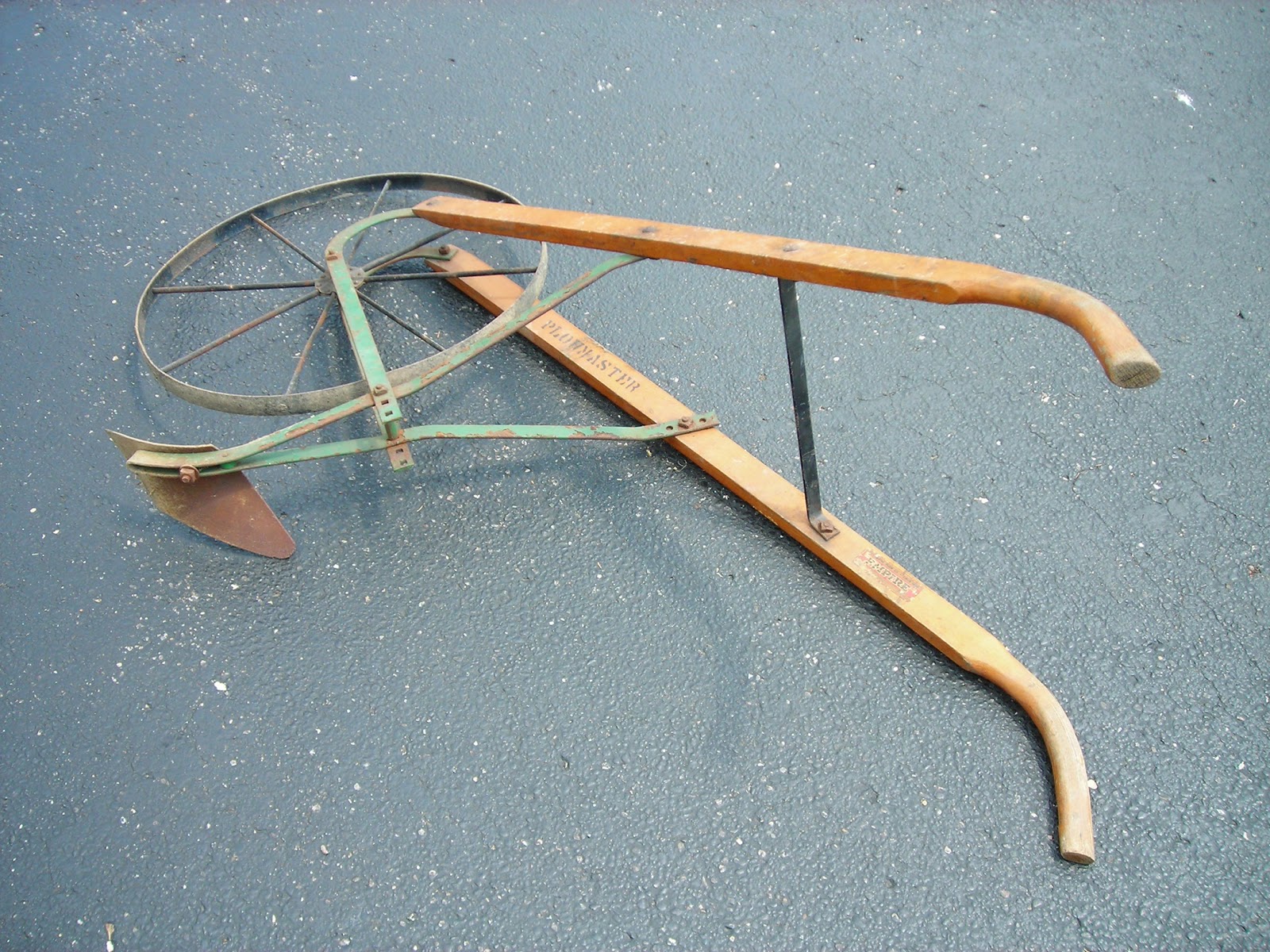
Let me return to Planting Day. My friend Steve had plowed my garden, and the soil was just right: rich and fluffy. I walked on pillows.

Plowmaster, Manufactured by “The Empire Plow Co. · Since 1849” 
And Distributed by the American Hardware & Supply Company 
Of Pittsburgh, Pennsylvania

My single-wheeled plow has one of the best jobs there is. It has to work only one day out of the year. It plows my rows on a glorious spring morning. Then it rests from its labors until another year rolls around. I use a Plowmaster, manufactured by “The Empire Plow Co. · Since 1849,” as the still-visible decal proclaims. According to a stencil along the inside of one of the handles, my plow was distributed by the American Hardware & Supply Company of Pittsburgh, Pennsylvania. Here are the Burpee’s seeds I carefully installed at precisely the correct depth and exactly the proper spacing—well, I tried to be careful, precise, and exact:

BEET Detroit Dark Red, Medium Top
BUSH BEAN Beananza
CARROT Mokum Hybrid
CUCUMBER Palace King Hybrid
MESCLUN Sweet Salad Mix
SUMMER SQUASH Cosmos Hybrid
SUMMER SQUASH Burpee’s Hybrid Zucchini
WINTER SQUASH Early Acorn Hybrid

FOUR O’CLOCK Marbles Mix
MARIGOLD Climax Mixed
SUNFLOWER Elegance
TITHONIA Sundance
ZINNIA Giant-Flowered Mix

The flowers, great for bouquets, will form a single-row border around my garden. I forgot to reserve space for an entrance, so I may have to step through the blossoms to reach my vegetables later on. Things could be worse than having to pass among petals to snap a fresh cucumber from its vine.

Those readers who follow my blogs know that I plant only those vegetables that my wild friends (rabbits and raccoons) generally ignore. I fully expect most of the leaves to be chewed off my bush beans, but I have found that the stalwart Beananzas need only a few leaves to function as reliable producers of beans for my dinner table. 

Turquoise Sky Above My Just-Planted Garden

I left room for eggplants, peppers, and tomatoes to be set out whenever good specimens are on sale. While planting, I often took the time to appreciate my surroundings: the playful breezes, the turquoise sky, and the exuberant melodies of the wrens. 

Rocks Marking Rows of Seeds 
And Areas for Plants to Be Added Later

I recognize the song of the wren. Alas, I am not yet schooled in identifying the voices of all the birds, but I will learn to name several of them this summer. From my present vantage point, the summer stretches happily toward infinity.   


Saturday, March 28, 2015

Why I Planted Squash


In a recent year, the seeds I planted in several adjacent rows in my vegetable garden failed to germinate. Faced with a blank space, I wished to fill it. Always be careful what you wish for! I bought summer squash seeds and formed half a dozen hills of two or three seeds each. All of them grew. And grew. And grew. When I began harvesting squash, I had delusions of keeping up. I collected a few and relished their rich flavor. But soon, I had too many! I was fetching them by the bushel basket nearly every day. I could not begin to give them away! The plants commandeered half of the garden. Each morning, when I went to the garden to pick the squash, I could not find spaces for my feet. From some crazy desire not to crush the thick leaf stems of my gigantic squash plants, I proceeded slowly on tiptoe, almost losing my balance and teetering above the squash jungle. To have fallen among the foliage in such a way as to have wiped out a few of the plants and to have slowed the production of squash would have been a blessing, but I never fell.

Squash Taking Over My Garden

Finally, I was forced to admit to myself that I had too many squash, and I began chucking their swollen bodies over the ravine into my creek. Poet and novelist Marge Piercy perfectly captured the same experience in her poem entitled “Attack of the Squash People,” which I first heard her read in 1980:


Piercy’s poem is hysterical in the fullest sense of the adjective. I know. So was I.

One of Several Baskets of Squash That I Harvested Every Morning
Harvesting Squash by the Wagonload

A digression is in order. I first met Piercy when I was earning my master’s degree in poetry writing at Indiana University. She addressed the workshop of ten poets in which I was enrolled. Our professor had mailed an anonymous sampling of our poems to Piercy in advance of her visit. After she was introduced, Piercy said, “I want to discuss one of your poems. It is ‘Wrestling.’ Who wrote it?” I raised my hand. Piercy complimented my work. Several years later, after I had finished my PhD and was teaching at Northern Kentucky University, Piercy came for a reading. At a social event, I asked her if she remembered my poem. She said she did. I had the joy of meeting Piercy on at least two additional occasions. One was at the home of a creative writing professor. Music was playing. Piercy was sitting beside the professor. I had walked over to Piercy to ask a question about poetry, but she brushed off my introductory remarks, stood, and commanded, “Dance with me!” Embarrassed as all get out, I danced. In a matter of seconds, everyone was dancing. I undoubtedly got more from dancing with Piercy for a few minutes than I would have received by asking my question; after all, she gave me something fun to mention in this blog!

My favorite way to prepare summer squash is basic. I slice it, boil it briefly, and put butter and salt on it. Yum! It’s almost as good as dancing with Marge Piercy!