Robert T. Rhode

Robert T. Rhode
Robert T. Rhode
Showing posts with label cat. Show all posts

Sunday, February 4, 2018

3. The Stage ... THE FARM IN PINE VILLAGE


Just then, Robert heard his father whistling as he opened the screen door to the east porch. Robert ran to help Joe put the round white filter in the special galvanized funnel that perfectly fit the opening in the top of the tall milk can. “Heigh-ho, heigh-ho, it’s home from work we go,” Joe whistled, while he lifted the white enameled milk bucket with its red rim and poured the morning’s fragrant milk into the funnel. Robert heard the merry pinging of the filtered liquid dripping and splashing within the can.

Rubbing his sleepy eyes, Charles stood in the kitchen doorway and yawned.

“Let’s sit down to breakfast,” Ida said.

Tumblers of fresh milk with a layer of yellow cream having risen to the top were arranged around the table. Halves of pink grapefruits rested in bowls at each place around the table. Mounds of sugar on top of the grapefruits were slowly turning a pale gray as the juice mingled with the granules. While Joe, Robert, and Charles spooned out the pink segments, Ida fried eggs until the edges of the whites were crispy brown. As the toaster popped with a pleasant “ker-ching” sound, she quickly slathered homemade butter on the slices and distributed the hot toast to each person.

“Joe, I’m worried about the cows,” Ida said. “If they get out, they’ll fall in that hole.”

A deep hole ….

“There’s nothing to worry about,” said Joe. “They’re not going to get out. If they were going to break through the pasture fence, it wouldn’t be there. It’d be where that old panel is by the hog lot.”

By this time, Robert was walking well wherever and whenever he wanted. He was talking much more often and fluently. He had practically forgotten the fact that, only two years earlier, his parents had to carry him everywhere while his feet ached. He had indeed forgotten his preliminary reluctance to speak.

As Charles had begun to attend first grade at the school across the road from home, Robert wanted to go to school, but his mother said he couldn’t.

“You’re only four. You have to wait another year,” she said, repeatedly.

Every afternoon, Robert stood in the window in his parents’ bedroom and watched for his brother to come home from school. The window in that room commanded the best view of the long sidewalk that ran to the southwest door of the school from a point across the highway from the driveway where Joe’s 1950 Chevrolet was parked, and it permitted Robert to see Charles striding past the automobile in the driveway to the gate through their white-board fence into the yard, thence along a narrow sidewalk to the porch east of the kitchen. Robert could hear the new Zenith television airing a telecast from its position atop a green Formica table with silvery tubular legs in the kitchen corner.

The television had not yet entirely replaced the dark brown 1949 Philco Bakelite radio standing amid the strands of white pop beads on Ida’s dresser, but the newfangled “TV” had certainly captured the family’s attention.

While Robert pulled back the white gauzy curtains to wait for Charles to appear, he wondered what Charles was learning that day and why he, Robert, was not allowed to learn the lessons at the same time. He felt miffed that he had to stay home through the long mornings and the boring afternoons while Charles got to participate in what must surely be the pleasures of schooling.

Then Robert would see Charles walking down the driveway, and envious thoughts were shoved aside by eager anticipation of playing until suppertime. Robert would run around the foot of the bed, through the kitchen, to the porch to greet Charles as he came through the screen door.

On this day, Robert scurried to welcome Charles home from school.

“What do you want to do until it’s time for chores?” Robert asked.

“What did you learn at school today?” Ida asked.

Charles smiled while he unzipped his gray jacket and hung it up. “We learned to subtract, but then, I already knew how to do that,” he replied to his mother.

Ida, who had taught elementary school, cast a worried glance at Robert. “Maybe I’m teaching you too much at home,” she said.

Robert tried to get his brother’s attention. “But what do you want to do?” he prompted.

“We’ll make a stage out of Tinkertoys,” Charles finally answered.

While Charles changed from his school clothes to his everyday clothes, Robert poured the Tinkertoys from their cans onto the rug in the living room.

“We’ll need a way to hang curtains on both sides of the stage,” Charles said, as he began to place green sticks in plain wooden disks. Robert handed the stage-maker whatever parts he needed as he called for them.

In a short time, a representative proscenium arch and stage stood before them, although they did not yet know the term “proscenium arch.” It was rather unstable but functional.

Robert and Charles were familiar with stages because their parents had taken them for lessons at Allen’s Dance Studio across from the Journal and Courier newspaper office in Lafayette.

Charles brought two plastic toy cows from the shelves where the toys were piled, and he held one in each hand on the stage. To Robert’s delight, he made them dance.

“Now we need curtains,” Charles said. “Mom,” he called, as he strode into the kitchen, “we need curtains for our stage.”

Ida was up to her elbows in suds while doing dishes. She turned and smiled at her son while wiping her hands on a towel. She returned to the living room and admired the stage before going to her room to pull material from a basket. She cut the curtains from leftover lightweight cotton and showed Charles how to pleat it while Robert looked on. Next, she used a knitting needle to pull a string through the pleats of both curtains. When she held up the curtains by the string, both boys were enchanted.

Charles carefully tied the string to both sides of the proscenium arch. He and Robert gently pulled the curtains closed and applauded their work. Obeying Charles’ instructions, Robert pulled the curtains open while Charles held the dancing cows on the stage. The effect was dramatic! They could hardly wait to show their father when he came in to get them for the evening chores.

Joe was generous in his praise of the stage. He kindly sat through a matinee performance of the dancing bovines. Then he announced that it was time to feed the real cows. Robert thought that maybe, when all human beings were out of sight, the real cows danced.

Sunday, January 28, 2018

2. The Incubator ... THE FARM IN PINE VILLAGE


For hours each day, Robert played with the kitten he had named Fuzz. Robert tantalizingly pulled a long piece of yarn, and Fuzz pounced on it, over and over. Robert sat with his pudgy knees out. His feet hurt too much to stand. Once, he overheard his mother speaking in worried tones to his father about how Robert was becoming too big to carry and that, at two years of age, he should be walking. After all, he was tall enough to see over the edge of the kitchen table! Ida thought Robert would not understand what she was saying. In her diary, she had expressed her fear that Robert was not as bright as his older brother, Charles. “Robert doesn’t say much,” she wrote. She acknowledged that, at the same age, Charles had been quite talkative.

But Robert did comprehend what she was saying, and he knew that, inevitably, he would be taken to Dr. Virgil Scheurich in Oxford, the town five miles to the north of Pine Village. During the consultation, Dr. Scheurich advised Ida and Joe to consult with a doctor in Lafayette who had enjoyed success with youngsters who could not walk.

Within a few days, Robert and his parents were seated in the office of the doctor, who said, “Why, his arches are as flat as pancakes! He needs corrective shoes with arch supports.” Right then and there, Joe drove to the B & W Shoe Company on the east side of the square. Proprietor Mr. Marion R. Baker took measurements of Robert’s feet and wrote an order for the shoes. Charles likewise was to receive a pair.

Several days later, when Mr. Baker ensured that the boys’ shoes fit them, Robert took his first walk in the style of black shoes with arch supports that he would wear until he entered college. (He continued to wear a pair when he performed as a member of the Indiana University Marching Hundred.) As a toddler, Robert found that he could walk without the same degree of pain that he had been feeling. With wide eyes, he looked up at his father, as if to say, “It’s a miracle!” Soon thereafter, Robert was walking routinely, and his parents did not have to carry him.

What of Robert’s reluctance to speak? Again, there were conversations in undertones between his parents. They decided to take him to a Lafayette clinic specializing in speech defects. He was tested, but so was his brother. Charles’ answers were to serve as a comparison. After the testing, the expert sat down with Ida and Joe. He began by saying, “There is nothing wrong with Robert’s intelligence. He recognizes more words than his brother knows—probably because Robert has been listening carefully. Robert’s reticence originates in his having a palate that is a bit higher than normal; for this reason, he says ‘wabbit,’ instead of ‘rabbit.’ You can help him to say his r’s by asking him to say ‘er’ first, then the rest of the word. ‘Er’-abbit, for ‘rabbit,’ or ‘Er’-obert, for ‘Robert.’ Avoid correcting him for mispronunciation; that makes him afraid to speak.”

Ida and Joe took the specialist’s advice to heart, and, little by little, Robert began talking without hesitation. At first, his “er” was drawn out, but, gradually, it shortened. Eventually, he was uttering the proper sound of the r at the beginning of words such as “reading.” He always felt a trifle self-conscious of the r sound whenever it fell at the beginning of a word, and that feeling never left him.

All too soon, Robert celebrated his third birthday. That Thursday, Ida invited his grandmother, named Kosie Rhode, and his great aunt, named Margaret Goddard, to the noon meal, called “dinner.” Everyone gathered around the five-leg drop-leaf table covered with an oilcloth in the kitchen. There was barely room for the six people to pull up their chairs. The windows and doors were open to permit the faint breezes of late July to waft through the hot room. On the table were platters of steaming roasting ears, fresh yeast rolls. Big bowls were filled with fluffy mashed potatoes and glistening green beans fresh from the garden. In the center was a mound of fried chicken. Sweet iced tea was poured over crackling ice cubes in the glasses with weighted bottoms that were used only for special occasions. Using a wooden mold, Ida had made a big block of butter from the fresh milk of the Holstein cows, and the yellow brick was topped with the shape of a rose. Beside it stood dishes filled with Ida’s crabapple jelly and wild grape jelly. The conversation flowed freely, with beloved Great Aunt Margaret telling stories from her childhood so humorous that laughter repeatedly burst forth. She had the gift of making any story amusing. Grandma Rhode listened intently and smiled prettily. Great Aunt Margaret’s first husband had been Grandma Rhode’s brother, who passed away many years earlier. Margaret’s second husband had been the veterinarian in town, and he, too, had gone to his reward. Grandma Rhode and her husband, Seymour Alfred Rhode, had divorced, and he lived in Indianapolis.

Dessert was an angel food cake with pink peppermint icing, which became Robert’s favorite cake, requested for his birthday year after year thereafter. Not long before the 25th of July, Robert had learned a stunt of which he was very proud. He would begin on all fours then lift one leg into the air. He would then waddle as quickly as he could on both hands and one foot while keeping the other foot as high as he could. He wanted to show Great Aunt Margaret and Grandma Rhode his newly acquired skill, so, after dinner, his mother moved her rocking chair to one side, thereby opening just enough floor space for Robert to demonstrate his acrobatic talent.

“Look at him go!” Great Aunt Margaret exclaimed. After taking a few rolling and rollicking steps on two hands and a foot, Robert stood up and accepted the gracious praise of his great aunt and grandmother. The company retired to the living room, but, finding it too hot for comfort, everyone gratefully sat down on the front porch, which faced the north and was less steamy than anywhere else. The adults took the metal chairs and the swing that hung from the ceiling, while Robert and Charles sat on the cool concrete floor. Family stories poured forth—tales of long ago that Robert and Charles absorbed and would remember years hence.

After Robert turned four, he began to feel as if everything were even more memorable than before. His life on the farm in Pine Village seemed permanent and secure. One morning, he awakened to the touch of something lightweight and soft brushing his face.

“Peep, peep, peep,” went the something.

Robert slowly opened his eyes. He saw his mother’s smiling face above an indistinct yellow blur. He focused on the blur. Just then, it moved.

“Peep, peep,” the blur said.

Robert focused more closely. The outlines of a duckling taking its first steps on the edge of the covers that Robert had pulled across his chin became clear.

“Careful!” Ida urged, as Robert abruptly slid upward to free his arms. “Don’t squeeze him! Hold him in the palm of your hand.”

Robert’s mother had a large Farm Master incubator, in which she hatched ducklings, goslings, and some of the chicks that Joe raised in his chicken business. Robert’s father purchased the majority of his chicks from Henderson Poultry in Oxford.

“He just hatched,” Ida said, while Robert held the downy yellow duckling in the palms of his hands. Its bright eyes sparkled. Its orange bill curved upward in what appeared to be a smile. “Come see the others,” said Ida, taking the duckling from Robert’s outstretched arms.

Robert followed his mother to the breezeway where the incubator stood. An early summer breeze carried the not unpleasant scent of eggs hatching in the warmth of the brown wooden box on green painted legs. Ida unlatched the door with its slender glass window on one side of the box and let it swing downward on its hinges. She slid the tray forward. Among the eggs on the tray were several that were pipping: that is, the bills of the ducklings inside were breaking away the shell on one end, so that the ducklings could emerge from the eggs. Robert stared in wonder at the tiny bills pushing at the inner lining where bits of the outer shell had fallen away. One damp duckling was all the way free and was drying while resting from her effort to escape.

Ida soon slid the tray back into position and swung the latch around. She had removed the damp duckling, which she gently set in the same bushel basket where she had placed the happy creature that had awakened Robert. Even though the morning was warm, a red heat lamp hanging by its black cord from a hook in the ceiling was suspended not far above the basket, which was lined with newspapers.

“Peep, peep, peep,” said Robert’s duckling. “Peep, peep,” replied its slightly damp, tired nest mate.

Saturday, January 20, 2018

1. The Discovery ... THE FARM IN PINE VILLAGE


This novel is dedicated to my dear friend Eleanor Yeager Stewart, who helped me realize that the worlds of our childhood were never somewhere else but always right within us. Here is part of my childhood world—almost exactly the way it was!

The tall foxtail of July waved like ornamental grasses above him. Across the road to the northeast stood the school with the grades and the high school all in one building made mostly of metal. Two long, angling sidewalks approached the two sets of doors spaced along the south front of the red-roofed one-story school. The white paint on the exterior walls made dusty spots on the fingertips when it was touched, and the scrubby evergreens along the foundation gave off a pleasant mid-summer scent. Straight to the north, dappled shadows played across the porch of Beulah Jones’ house surrounded by old maples. The drive to the parking lot between the school and the gymnasium curved past sawed-off poles spaced to deter traffic from entering the playground. Behind the gym was a fringe of trees bordering Pine Creek. Had he been taller, he might have seen Beulah in the vegetable garden tucked behind her home. She wore a straw hat and pretty gloves made for gardening. Her white hair curled stylishly beneath the hat’s broad brim. She seemed perfectly at ease bending over her tomatoes and hunkering down to pull the weeds among her onions.

The sky was the pale blue shade of a hazy summer. Rows of cumulus clouds floated slowly toward the east—so slowly that their motion was almost undetectable. Now and then, the rasping crescendo of a cicada in the nearby catalpa tree caught his attention before the sound trailed away. His mother, Ida, was hoeing industriously in her large garden. Plenty of hoeing was needed in July, for the ground had hardened under the baking sunshine and firmly gripped the roots of the weeds that were shooting upward and outward at an alarming rate each day. Unlike Beulah, his mother wore no hat. The tight curls of her “perm” glistened black while she threw her sun-reddened shoulders into the work of hacking away at the pigweed and the lamb’s quarters.

He couldn’t see his mother, either, even though she was only thirty feet away. He couldn’t see the houses of Pine Village in an arc from the north to the west. His mother’s garden on the south side of State Route 26 and the playground on the north side defined the east edge of the town. The cozy homes nestled securely among the shade trees. Robins sailed down from the low branches to pull worms from the lawns, and katydids droned pleasantly in the foliage. Occasionally, pickups with curving fenders and livestock panels around the beds ambled along the highway. Horses in the narrow meadow behind Jim Eberle’s house whinnied happily.

He saw only the nodding brushes of the foxtail all around him and a spot of blue sky and white cloud above. Ida had stamped her sandaled feet in the thick growth of foxtail until she had hollowed out a “playpen” for little Robert, who had just turned two. The weeds were impenetrable there in shade of the lone catalpa on the south edge of the garden, and she knew that Robert could go nowhere. He sat with his feet almost together and his dimpled knees to either side. He indolently played with the long stems that his mother had trod.

Suddenly, the weeds parted and eyes stared at Robert. His blue eyes must have registered just as much surprise as he saw in the blue eyes that looked back at him. To get his mother’s attention, Robert shouted. She dropped her hoe and came running as fast as she could between the rows of potatoes. Soon, her face with the glasses almost slipping off her nose peered down from the circle of sky above Robert.

“It’s a kitty!” she exclaimed, reaching downward and scooping up the ivory-colored kitten, which mewed, much to Robert’s delight. The fur was scarcely any lighter than Robert’s hair, for he was a towhead. Ida set down the kitten only long enough to lift Robert in one arm while she reached for the kitten again with her free hand. Taking long strides so that Robert wouldn’t get too heavy, Ida rushed toward the house. When she reached the gate that leaned from the corner of the old smokehouse, her steps were easier in the mowed grass on the other side. She swung open the screened door of the breezeway between the smokehouse, now a storage room, and the kitchen. She was glad to set Robert down while she kept a firm hold on the kitten.

“We’ll feed him some cream,” she said, disappearing into the kitchen and soon reappearing with a saucer in hand. There in the breezeway, she placed the saucer before the wobbly kitten and poured a little cream that she had drawn from the separator just that morning. It was a Marvel Gravity Dilution Cream Separator made by Superior Sheet Metal Works Company of Indianapolis, as a silvery plate on the dark blue three-legged can proclaimed. Even though Robert’s feet hurt, as they did whenever he stood, he hardly noticed the ache because he was so entranced with the kitten, which overcame its fear and flicked its little pink tongue into the fresh cream. “After he has drunk all he wants, you can pet him a little,” said Ida.

Silently, she and little Robert watched the kitten contentedly lapping the surface of the liquid. It drank almost every drop. Then Ida showed Robert how to pet the creature lightly so as not to hurt it.

“What shall we call him?” Ida asked Robert. Because the kitten was so soft, Robert said, “Fuzz.” Ida laughed. “That’s a good name for him!” she agreed.

At that moment, Robert’s father came to the porch on the opposite side of the kitchen from the breezeway. “Joe, come here,” Ida called to her husband. “Look what Robert found!”

In his dark blue overalls and short-sleeved shirt, bleached almost white, Joe hurried through the kitchen and out to the breezeway. He took off his seed corn cap and ran his hand over his balding head. His eyes twinkled and his face broke into a smile. “Well, where did you find a kitten?” he asked his wife.

“Robert found him,” Ida explained. “I heard Robert yell, and here was the kitten standing by Robert in the weeds. His name is Fuzz. Robert named him.”

“We’re going to keep him, are we?” Joe wanted to know.

“He’s Robert’s kitten,” Ida answered.

Robert looked up at his father’s merry eyes and his mother’s big smile. He could hardly believe his luck in getting to have such a miraculous thing as a soft, warm kitten, which had begun to purr under his careful touch. Robert would remember that day for the rest of his life.

Sunday, May 31, 2015

My Summer in a Garden: Planting Day

In 1870, Charles Dudley Warner (1829–1900) published My Summer in a Garden, a book that memorialized Warner’s gardening experiences and that elevated his cat named Calvin to nearly heroic status. The essays comprising the volume first appeared in serialized format in The Hartford Courant. The author’s name might have been that of a character in a 1930s Hollywood movie: a person of delicacy, refinement, and hauteur, the sadly inevitable accompaniment to such refinement and delicacy. Only three years after Boston’s baronial publisher James R. Osgood placed Warner’s gardening book in the hands of appreciative readers, Warner collaborated with Mark Twain in that groundbreaking work entitled The Gilded Age: A Tale of Today. As a subscription book from the American Publishing Company of Hartford, Connecticut, The Gilded Age broke the bonds of Brahmin imprimatur by appealing to middle class readers everywhere.

Cover of 1898 Riverside Edition 
Of Charles Dudley Warner’s My Summer in a Garden

Such splendid chutzpah! To co-author a work with Twain, famed author of Innocents Abroad and Roughing It, required self-confidence or a reasonable facsimile. Having worked as an editor in Hartford, Connecticut (Warner was buried in Hartford’s Cedar Hill Cemetery; Twain was a pall-bearer.), Warner and Twain shared a love for Hartford. Twain moved there in 1871 and began construction of his elaborate house (https://www.marktwainhouse.org/) in the same year that the author of “The Celebrated Jumping Frog of Calaveras County” joined Warner in publishing The Gilded Age, the title of which became an epithet for the late 1800s: an era of deep social problems and wide aristocratic corruption hidden behind a thin golden veneer of rich sophistication. Warner and Twain shared more than a passion for Hartford; they were leaders in a growing movement to cause literature to imitate life realistically. Despite their campaign for such literary realism, which fought against the Romantic tendency to moralize, they carried the banners of their Puritan and Presbyterian upbringing when they sought a moral standard capable of saving a nation from evil.

Cover of My Copy of the First Edition of The Gilded Age 
By Charles Dudley Warner and Mark Twain
And the Elegant Cursive Handwriting of the Book’s First Owner

But all of this background is meant simply to introduce a series of blogs about my vegetable garden for this year. I see myself as embarking on a project not unlike Warner’s “summer in a garden.” Unfortunately, I have no cat Calvin (with a name invoking that of John Calvin, the exponent of Presbyterian predestination) to lighten the tone. Apparently, I do have chutzpah sufficient to set my blogs alongside the work of Warner, who served as an editor at Harper’s Magazine during its heyday. It was Warner, not Twain, who said, “Everybody complains about the weather, but nobody does anything about it.” In his introduction to My Summer in a Garden, Warner writes, “These garden letters began to blossom every week … .” I hope my blogs will bloom similarly.

I will begin with the weather that Warner mentioned. Soon after I planted my garden on May 2nd, a Saturday, temperatures warmed considerably. Seeds that might have taken two weeks to sprout were poking above the ground after only seven or eight days! I found myself carrying buckets of water from the hand pump to the rows so as to give proper encouragement to the infant plants. I am ahead of myself, though.

Hand Pump and Buckets for Watering My Garden

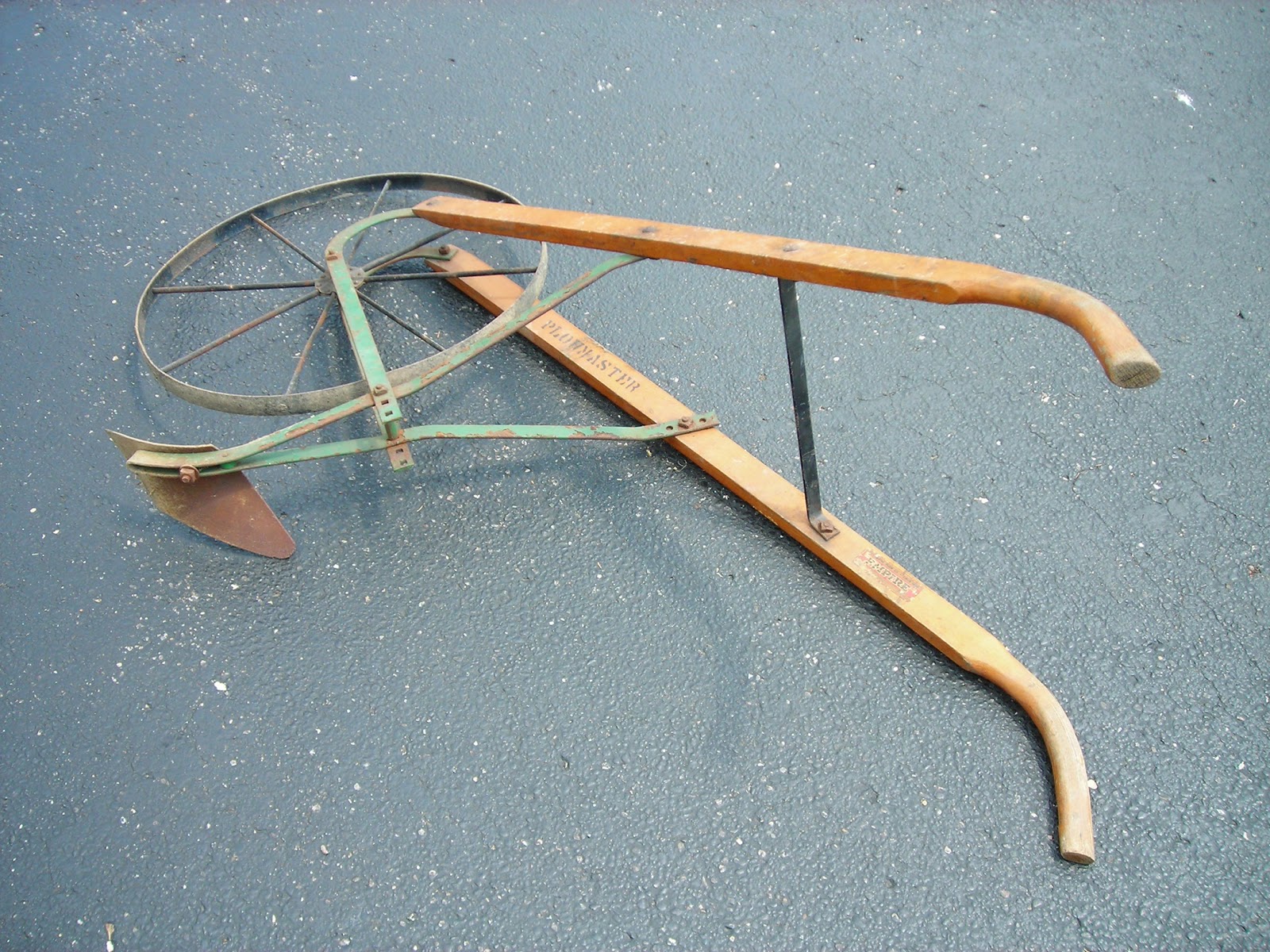
Let me return to Planting Day. My friend Steve had plowed my garden, and the soil was just right: rich and fluffy. I walked on pillows.

Plowmaster, Manufactured by “The Empire Plow Co. · Since 1849” 
And Distributed by the American Hardware & Supply Company 
Of Pittsburgh, Pennsylvania

My single-wheeled plow has one of the best jobs there is. It has to work only one day out of the year. It plows my rows on a glorious spring morning. Then it rests from its labors until another year rolls around. I use a Plowmaster, manufactured by “The Empire Plow Co. · Since 1849,” as the still-visible decal proclaims. According to a stencil along the inside of one of the handles, my plow was distributed by the American Hardware & Supply Company of Pittsburgh, Pennsylvania. Here are the Burpee’s seeds I carefully installed at precisely the correct depth and exactly the proper spacing—well, I tried to be careful, precise, and exact:

BEET Detroit Dark Red, Medium Top
BUSH BEAN Beananza
CARROT Mokum Hybrid
CUCUMBER Palace King Hybrid
MESCLUN Sweet Salad Mix
SUMMER SQUASH Cosmos Hybrid
SUMMER SQUASH Burpee’s Hybrid Zucchini
WINTER SQUASH Early Acorn Hybrid

FOUR O’CLOCK Marbles Mix
MARIGOLD Climax Mixed
SUNFLOWER Elegance
TITHONIA Sundance
ZINNIA Giant-Flowered Mix

The flowers, great for bouquets, will form a single-row border around my garden. I forgot to reserve space for an entrance, so I may have to step through the blossoms to reach my vegetables later on. Things could be worse than having to pass among petals to snap a fresh cucumber from its vine.

Those readers who follow my blogs know that I plant only those vegetables that my wild friends (rabbits and raccoons) generally ignore. I fully expect most of the leaves to be chewed off my bush beans, but I have found that the stalwart Beananzas need only a few leaves to function as reliable producers of beans for my dinner table. 

Turquoise Sky Above My Just-Planted Garden

I left room for eggplants, peppers, and tomatoes to be set out whenever good specimens are on sale. While planting, I often took the time to appreciate my surroundings: the playful breezes, the turquoise sky, and the exuberant melodies of the wrens. 

Rocks Marking Rows of Seeds 
And Areas for Plants to Be Added Later

I recognize the song of the wren. Alas, I am not yet schooled in identifying the voices of all the birds, but I will learn to name several of them this summer. From my present vantage point, the summer stretches happily toward infinity.