Robert T. Rhode

Robert T. Rhode
Robert T. Rhode
Showing posts with label Charles Dudley Warner. Show all posts

Sunday, July 17, 2016

Gardening 6 (Last Installment in This Series)


“Lettuce is like a conversation: it must be fresh and crisp, so sparkling that you scarcely notice the bitter in it.”

“I began digging my potatoes, by the way, about the 4th of July; and I fancy I have discovered the right way to do it. … I do not pull them up, and shake them out, and destroy them; but I dig carefully at the side of the hill, remove the fruit which is grown, leaving the vine undisturbed: and my theory is, that it will go on bearing, and submitting to my exactions, until the frost cuts it down.”

—My Summer in a Garden by Charles Dudley Warner

Well, I planted too much lettuce, or it grew too vigorously. Next year, one row will more than suffice. This year, I devoted two rows to “fresh,” “crisp,” “sparkling” lettuce. I understand Charles Dudley Warner’s adjectives and find them appropriate, but I might have resorted to “velvety” and “delightful” to describe the texture and the flavor of the lettuce that grew from the seeds I purchased at Divers in Middletown. Is there bitterness in lettuce? Perhaps in some, but mine is sweet and mildly spicy! I apply no laboratory chemicals (fertilizers, herbicides, insecticides, fungicides) to my garden; consequently, a leaf of lettuce that I have grown is as perfect and unspoiled as it can be. As I trust the decaying vegetation of autumn to produce ample fertilizer for the seasons ahead, I need no commercial fertilizers; besides, I improved the soil with horse manure not that many years ago. As for bugs, I permit the garden to groom itself, and I have had no substantial losses from insects or slugs. I keep the garden weeded with meticulous care. Having done so many things right, I still was wrong in my estimate of how much lettuce to plant. My excuse is that the relatively weak production of lettuce in the previous two years prompted me to thickly sow two rows this year. Too much! Stand back!

My Garden Growing Nicely on June 19, 2016

Then there are my plump potatoes. I have dug them gently from the side, as Warner recommends, and I have found that he is right: the plants continue to produce for a much longer season than I would have guessed! Even though I have managed to extend the potato harvest, the life of my garden is a spring and early summer life. By the end of July, baked earth is no longer patiently watered from buckets pumped by hand from the icy depth of my spring-fed well, and weeds—especially grasses—have defeated my sustained effort to keep the garden focused on the plants that I grew. Nature always wins. In those impossibly hot afternoons, flowers riot in the border, but no more vegetables remain to be collected.

Sunflowers Guarding Replanted Beans on June 19, 2016

I have thought about developing a planting schedule that might keep my garden active through the fall and even into the early winter, but, somehow, I always lose interest around June. Maybe I am too tired from pulling weeds. Perhaps the deer flies discourage me. Whatever the reason, I give up and let the garden go wherever it wants to go without my guidance. Only in the dark winter months does my enthusiasm for gardening become rekindled, so that I begin to anticipate the coming of spring and the opportunity to plant anew.

... but this year may be different. As is said, watch this space!

Garden Looking Lovely on June 29, 2016
Produce Beginning to Roll in on June 29, 2016
Sunflowers Surrounding the Garden on July 6, 2016
Sunflowers Bobbing in the Breeze


Sunday, June 7, 2015

My Summer in a Garden: Panic Sets In


Around the third week of May, panic sets in. Lettuce leaves are almost large enough for salads, beets are up but disappointingly sparse, carrots are up in one row but inexplicably not in the next row, potatoes are here and there but not everywhere, onions are going strong, beans are up but stripped of their leaves by varmints, cucumbers are spotty, squash are up in some hills but not in others, flowers are few and far between—and weeds are thick! I worry that I will not succeed in keeping the weeds down. I put on gloves, seize a trowel, and start on the lettuce rows, painstakingly pulling the larger weeds and scraping the smaller ones. I make my way slowly up and down the rows. I wonder why so many seeds failed to sprout and why so many promising chunks of potatoes rotted without forming new plants. I wonder whether my beans have fallen victim to rabbits or groundhogs.

Plants Coming Up on May 19th

I need to sharpen a hoe so that I can clear the spaces in between the rows. Last year, I happened to be listening to the radio in my car when a gardening expert suggested the use of a sharp hoe to clip weeds about a quarter of an inch beneath the surface of the soil. I had always pulled weeds by hand, but the expert said that doing so merely encourages many new weeds to sprout. Even though the gardening season was well advanced, I followed the expert’s advice with great success. This year, I intend to cut the weeds that have arisen in the walkways between the rows, but I still need to grind my hoe to a sharp edge. In his first soliloquy, Hamlet says, “ … ‘tis an unweeded garden, / That grows to seed; things rank and gross in nature / Possess it merely.” Hamlet is speaking metaphorically, but, when I look upon my garden, I see no metaphor. I see only weeds, rank and gross weeds, that are about to possess my carefully planted rows! The world in front of me is literally “an unweeded garden”!

I vow to purchase a few packets of flower seeds to try to fill in my border. (Ultimately, I do not fulfill my vow.) I decide that the gaps in my beets are too short for reseeding, and, besides, it’s too late to be planting beets. I must learn to live with imperfection. I profoundly hope the beans will live long enough to set on more leaves, but wild animals have stripped many of them down to stalks that are only three inches tall! I reassure myself that the cucumbers and squash that I have will spread to cover the area in such a way that my fears of a waste land are unfounded.

Vegetables Emerging on May 19th

Unnerved all the same, I stand helpless, mourning the loss of fun, now replaced by work. Can I work hard enough to salvage a garden here? Can I rescue the little I have?

Rows Weeded and Watered by May 24th

And, suddenly, I remember. It is this way every summer! In my experience with gardening, nothing ever works out the way I planned. Nature is unpredictable. The fun lies in witnessing what happens after all. Through weeding, I can exercise a little control, but the immensely complicated combinations of rain, sun, wind, temperature, humidity, fauna, and cell division are far beyond me! Acknowledging how small a part I play in this venture called “a garden,” I echo Abraham and say, “God will provide.”


Sunday, May 31, 2015

My Summer in a Garden: Planting Day

In 1870, Charles Dudley Warner (1829–1900) published My Summer in a Garden, a book that memorialized Warner’s gardening experiences and that elevated his cat named Calvin to nearly heroic status. The essays comprising the volume first appeared in serialized format in The Hartford Courant. The author’s name might have been that of a character in a 1930s Hollywood movie: a person of delicacy, refinement, and hauteur, the sadly inevitable accompaniment to such refinement and delicacy. Only three years after Boston’s baronial publisher James R. Osgood placed Warner’s gardening book in the hands of appreciative readers, Warner collaborated with Mark Twain in that groundbreaking work entitled The Gilded Age: A Tale of Today. As a subscription book from the American Publishing Company of Hartford, Connecticut, The Gilded Age broke the bonds of Brahmin imprimatur by appealing to middle class readers everywhere.

Cover of 1898 Riverside Edition 
Of Charles Dudley Warner’s My Summer in a Garden

Such splendid chutzpah! To co-author a work with Twain, famed author of Innocents Abroad and Roughing It, required self-confidence or a reasonable facsimile. Having worked as an editor in Hartford, Connecticut (Warner was buried in Hartford’s Cedar Hill Cemetery; Twain was a pall-bearer.), Warner and Twain shared a love for Hartford. Twain moved there in 1871 and began construction of his elaborate house (https://www.marktwainhouse.org/) in the same year that the author of “The Celebrated Jumping Frog of Calaveras County” joined Warner in publishing The Gilded Age, the title of which became an epithet for the late 1800s: an era of deep social problems and wide aristocratic corruption hidden behind a thin golden veneer of rich sophistication. Warner and Twain shared more than a passion for Hartford; they were leaders in a growing movement to cause literature to imitate life realistically. Despite their campaign for such literary realism, which fought against the Romantic tendency to moralize, they carried the banners of their Puritan and Presbyterian upbringing when they sought a moral standard capable of saving a nation from evil.

Cover of My Copy of the First Edition of The Gilded Age 
By Charles Dudley Warner and Mark Twain
And the Elegant Cursive Handwriting of the Book’s First Owner

But all of this background is meant simply to introduce a series of blogs about my vegetable garden for this year. I see myself as embarking on a project not unlike Warner’s “summer in a garden.” Unfortunately, I have no cat Calvin (with a name invoking that of John Calvin, the exponent of Presbyterian predestination) to lighten the tone. Apparently, I do have chutzpah sufficient to set my blogs alongside the work of Warner, who served as an editor at Harper’s Magazine during its heyday. It was Warner, not Twain, who said, “Everybody complains about the weather, but nobody does anything about it.” In his introduction to My Summer in a Garden, Warner writes, “These garden letters began to blossom every week … .” I hope my blogs will bloom similarly.

I will begin with the weather that Warner mentioned. Soon after I planted my garden on May 2nd, a Saturday, temperatures warmed considerably. Seeds that might have taken two weeks to sprout were poking above the ground after only seven or eight days! I found myself carrying buckets of water from the hand pump to the rows so as to give proper encouragement to the infant plants. I am ahead of myself, though.

Hand Pump and Buckets for Watering My Garden

Let me return to Planting Day. My friend Steve had plowed my garden, and the soil was just right: rich and fluffy. I walked on pillows.

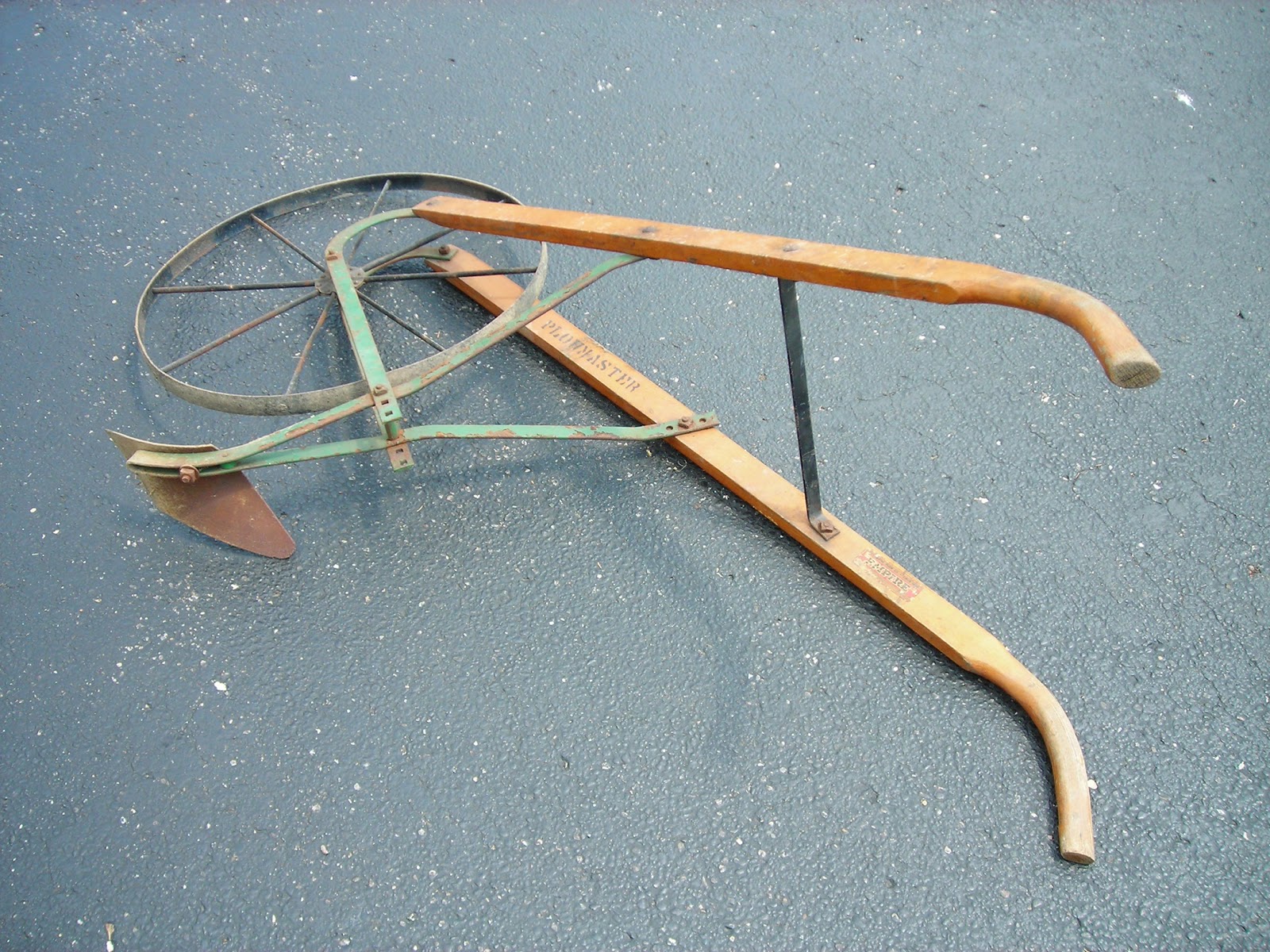
Plowmaster, Manufactured by “The Empire Plow Co. · Since 1849” 
And Distributed by the American Hardware & Supply Company 
Of Pittsburgh, Pennsylvania

My single-wheeled plow has one of the best jobs there is. It has to work only one day out of the year. It plows my rows on a glorious spring morning. Then it rests from its labors until another year rolls around. I use a Plowmaster, manufactured by “The Empire Plow Co. · Since 1849,” as the still-visible decal proclaims. According to a stencil along the inside of one of the handles, my plow was distributed by the American Hardware & Supply Company of Pittsburgh, Pennsylvania. Here are the Burpee’s seeds I carefully installed at precisely the correct depth and exactly the proper spacing—well, I tried to be careful, precise, and exact:

BEET Detroit Dark Red, Medium Top
BUSH BEAN Beananza
CARROT Mokum Hybrid
CUCUMBER Palace King Hybrid
MESCLUN Sweet Salad Mix
SUMMER SQUASH Cosmos Hybrid
SUMMER SQUASH Burpee’s Hybrid Zucchini
WINTER SQUASH Early Acorn Hybrid

FOUR O’CLOCK Marbles Mix
MARIGOLD Climax Mixed
SUNFLOWER Elegance
TITHONIA Sundance
ZINNIA Giant-Flowered Mix

The flowers, great for bouquets, will form a single-row border around my garden. I forgot to reserve space for an entrance, so I may have to step through the blossoms to reach my vegetables later on. Things could be worse than having to pass among petals to snap a fresh cucumber from its vine.

Those readers who follow my blogs know that I plant only those vegetables that my wild friends (rabbits and raccoons) generally ignore. I fully expect most of the leaves to be chewed off my bush beans, but I have found that the stalwart Beananzas need only a few leaves to function as reliable producers of beans for my dinner table. 

Turquoise Sky Above My Just-Planted Garden

I left room for eggplants, peppers, and tomatoes to be set out whenever good specimens are on sale. While planting, I often took the time to appreciate my surroundings: the playful breezes, the turquoise sky, and the exuberant melodies of the wrens. 

Rocks Marking Rows of Seeds 
And Areas for Plants to Be Added Later

I recognize the song of the wren. Alas, I am not yet schooled in identifying the voices of all the birds, but I will learn to name several of them this summer. From my present vantage point, the summer stretches happily toward infinity.