Robert T. Rhode

Robert T. Rhode
Robert T. Rhode
Showing posts with label bird. Show all posts

Sunday, June 19, 2016

Gardening 2


“The influence of her taste was seen also in the family garden, where the ornamental began to mingle with the useful; whole rows of fiery marigolds and splendid hollyhocks bordered the cabbage beds, and gigantic sunflowers lolled their broad, jolly faces over the fences, seeming to ogle most affectionately the passers-by.”

     —“Wolfert Webber, Or Golden Dreams,” in Tales of a Traveler by Washington Irving

A few years ago, I had the happy inspiration to surround my vegetable garden with a floral border mixing “fiery marigolds” and “gigantic sunflowers.” My thought was to cut as many bouquets as I might like, and I have gathered armloads of blossoms from the prolific display of flowers surrounding my beans and squash. Even so, I have experienced an irrational reluctance to turn to my borders for blooms. The profusion of petals is so spectacular en masse and such an invitation to butterflies and birds that I am hesitant to claim any zinnias or cosmos for my kitchen or living room. To demur is silly. After all, at the end of the season, the flowers will have gone to seed and, in the spring, their stalks will be plowed under. I might as well remain true to my vision and cut flowers at will.

My Garden on May 12, 2016

Unlike the character in Irving’s tale, I have no cabbages for my flowers to accompany. While I like cooked cabbage—especially on St. Patrick’s Day—I seldom have enough use for cabbage to justify growing any in my garden. When I was growing up, my mother planted rows of cabbages. For exhibits at the annual 4-H fair, we walked up and down in search of the largest cabbage, a heavy one with great waxy leaves spread so wide that it was all I could do to hold it in front of me and to lug it back to the house. In retrospect, I wonder what my mother did with all that cabbage. When I was very young, she made sauerkraut in ancient crocks that huddled in the darkness of a cellar beneath our smokehouse, but, by the time I participated in the gardening projects at the county fair, she no longer made kraut. Our family ate plenty of cooked cabbage, but we could not possibly have consumed as much as my mother grew. A cabbage conundrum!

Sunflowers I have in abundance! Small and large, yellow and red, my sunflowers may not “ogle most affectionately the passers-by,” but they serve as banquets for birds and squirrels. At precisely the moment when their diamond-pattern seed cushions become ready for shelling, the birds come to help themselves to the bounty. In only a day or two, the seeds are pecked loose. The birds are not tidy. They drop many seeds on the ground. The squirrels do not pause to thank their feathered compatriots; rather, they busily comb the ground to scavenge every seed abandoned by the birds.

Alas! I have no hollyhocks. I admire them in the distant yards of neighbors, but I grow none of my own. Up close, they are so dry, dusty, insect-ridden, and full of spiders that I am loath to plant any.

My borders feature the delicately arching cosmos, the frankly sturdy marigold, the utterly dependable zinnia, and the wonderfully robust tithonia in rainbows of hue and tint. Going to the garden to fetch a batch of beans is a treat for the eyes!       

Sunday, May 31, 2015

My Summer in a Garden: Planting Day

In 1870, Charles Dudley Warner (1829–1900) published My Summer in a Garden, a book that memorialized Warner’s gardening experiences and that elevated his cat named Calvin to nearly heroic status. The essays comprising the volume first appeared in serialized format in The Hartford Courant. The author’s name might have been that of a character in a 1930s Hollywood movie: a person of delicacy, refinement, and hauteur, the sadly inevitable accompaniment to such refinement and delicacy. Only three years after Boston’s baronial publisher James R. Osgood placed Warner’s gardening book in the hands of appreciative readers, Warner collaborated with Mark Twain in that groundbreaking work entitled The Gilded Age: A Tale of Today. As a subscription book from the American Publishing Company of Hartford, Connecticut, The Gilded Age broke the bonds of Brahmin imprimatur by appealing to middle class readers everywhere.

Cover of 1898 Riverside Edition 
Of Charles Dudley Warner’s My Summer in a Garden

Such splendid chutzpah! To co-author a work with Twain, famed author of Innocents Abroad and Roughing It, required self-confidence or a reasonable facsimile. Having worked as an editor in Hartford, Connecticut (Warner was buried in Hartford’s Cedar Hill Cemetery; Twain was a pall-bearer.), Warner and Twain shared a love for Hartford. Twain moved there in 1871 and began construction of his elaborate house (https://www.marktwainhouse.org/) in the same year that the author of “The Celebrated Jumping Frog of Calaveras County” joined Warner in publishing The Gilded Age, the title of which became an epithet for the late 1800s: an era of deep social problems and wide aristocratic corruption hidden behind a thin golden veneer of rich sophistication. Warner and Twain shared more than a passion for Hartford; they were leaders in a growing movement to cause literature to imitate life realistically. Despite their campaign for such literary realism, which fought against the Romantic tendency to moralize, they carried the banners of their Puritan and Presbyterian upbringing when they sought a moral standard capable of saving a nation from evil.

Cover of My Copy of the First Edition of The Gilded Age 
By Charles Dudley Warner and Mark Twain
And the Elegant Cursive Handwriting of the Book’s First Owner

But all of this background is meant simply to introduce a series of blogs about my vegetable garden for this year. I see myself as embarking on a project not unlike Warner’s “summer in a garden.” Unfortunately, I have no cat Calvin (with a name invoking that of John Calvin, the exponent of Presbyterian predestination) to lighten the tone. Apparently, I do have chutzpah sufficient to set my blogs alongside the work of Warner, who served as an editor at Harper’s Magazine during its heyday. It was Warner, not Twain, who said, “Everybody complains about the weather, but nobody does anything about it.” In his introduction to My Summer in a Garden, Warner writes, “These garden letters began to blossom every week … .” I hope my blogs will bloom similarly.

I will begin with the weather that Warner mentioned. Soon after I planted my garden on May 2nd, a Saturday, temperatures warmed considerably. Seeds that might have taken two weeks to sprout were poking above the ground after only seven or eight days! I found myself carrying buckets of water from the hand pump to the rows so as to give proper encouragement to the infant plants. I am ahead of myself, though.

Hand Pump and Buckets for Watering My Garden

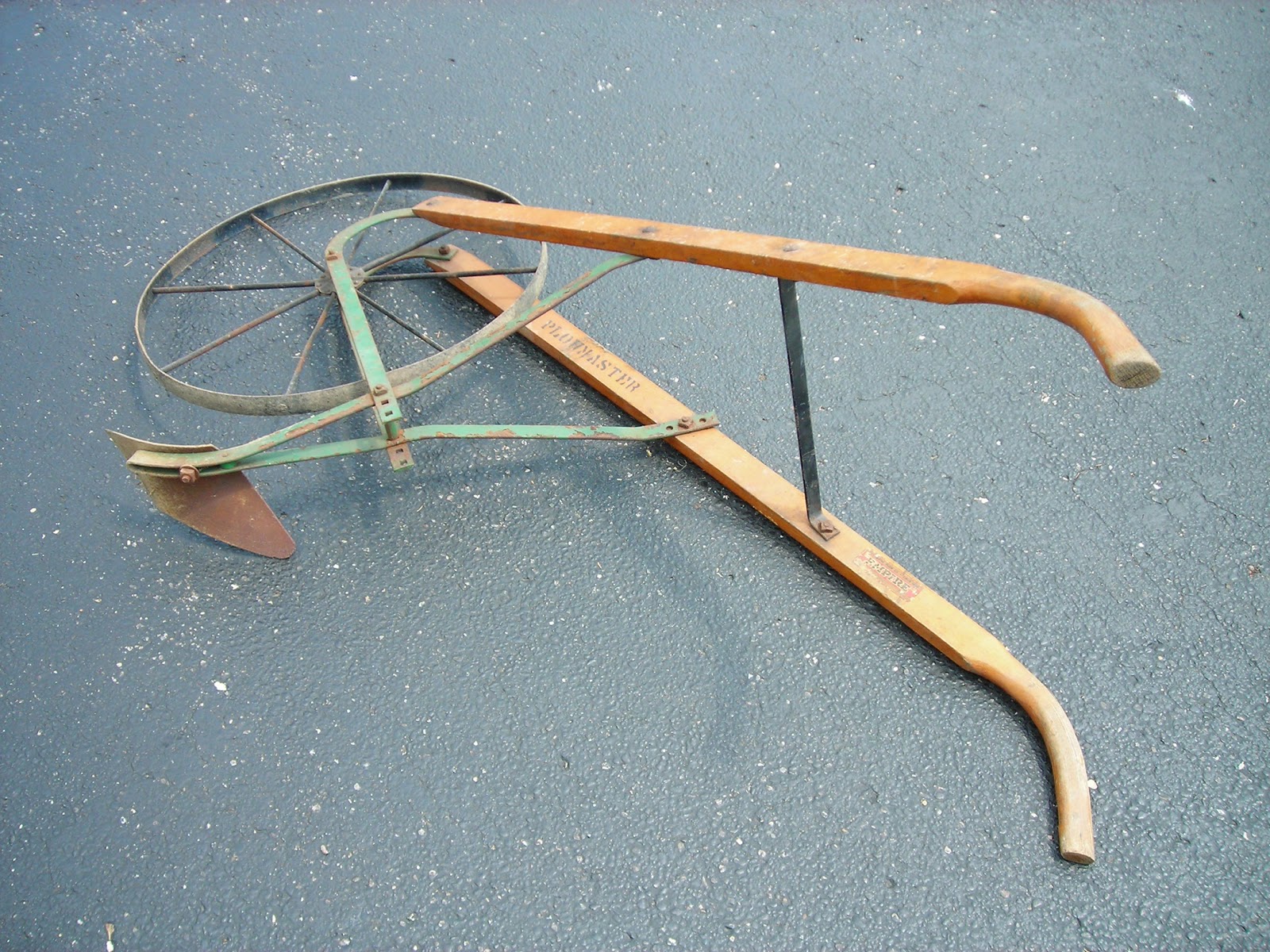
Let me return to Planting Day. My friend Steve had plowed my garden, and the soil was just right: rich and fluffy. I walked on pillows.

Plowmaster, Manufactured by “The Empire Plow Co. · Since 1849” 
And Distributed by the American Hardware & Supply Company 
Of Pittsburgh, Pennsylvania

My single-wheeled plow has one of the best jobs there is. It has to work only one day out of the year. It plows my rows on a glorious spring morning. Then it rests from its labors until another year rolls around. I use a Plowmaster, manufactured by “The Empire Plow Co. · Since 1849,” as the still-visible decal proclaims. According to a stencil along the inside of one of the handles, my plow was distributed by the American Hardware & Supply Company of Pittsburgh, Pennsylvania. Here are the Burpee’s seeds I carefully installed at precisely the correct depth and exactly the proper spacing—well, I tried to be careful, precise, and exact:

BEET Detroit Dark Red, Medium Top
BUSH BEAN Beananza
CARROT Mokum Hybrid
CUCUMBER Palace King Hybrid
MESCLUN Sweet Salad Mix
SUMMER SQUASH Cosmos Hybrid
SUMMER SQUASH Burpee’s Hybrid Zucchini
WINTER SQUASH Early Acorn Hybrid

FOUR O’CLOCK Marbles Mix
MARIGOLD Climax Mixed
SUNFLOWER Elegance
TITHONIA Sundance
ZINNIA Giant-Flowered Mix

The flowers, great for bouquets, will form a single-row border around my garden. I forgot to reserve space for an entrance, so I may have to step through the blossoms to reach my vegetables later on. Things could be worse than having to pass among petals to snap a fresh cucumber from its vine.

Those readers who follow my blogs know that I plant only those vegetables that my wild friends (rabbits and raccoons) generally ignore. I fully expect most of the leaves to be chewed off my bush beans, but I have found that the stalwart Beananzas need only a few leaves to function as reliable producers of beans for my dinner table. 

Turquoise Sky Above My Just-Planted Garden

I left room for eggplants, peppers, and tomatoes to be set out whenever good specimens are on sale. While planting, I often took the time to appreciate my surroundings: the playful breezes, the turquoise sky, and the exuberant melodies of the wrens. 

Rocks Marking Rows of Seeds 
And Areas for Plants to Be Added Later

I recognize the song of the wren. Alas, I am not yet schooled in identifying the voices of all the birds, but I will learn to name several of them this summer. From my present vantage point, the summer stretches happily toward infinity.   


Sunday, March 8, 2015

Why I Plant Beets


Beets are one of my favorite vegetables. I have grown several varieties from dark purple to brilliant red, from yellow to striped when cut. Experience has taught me that a medium-sized red beet is the best for cooking and for canning.

Beets are fun to plant. The seeds are large enough to grip so that they do not fall too thickly in the row, and they are just heavy enough to drop where I want them, rather than blowing to one side on a breeze. Some websites say to soak such tough little seeds overnight, but I have never done that. My beets have germinated well regardless. I plant them about half an inch down from the soil surface and about three inches apart.

Beets are fun to grow. I watch for the first leaves to push above the soil. When I see them, I check on the plants often. After six weeks of checking, I grow bored with looking to see if I can spot the top of a beet protruding above the soil that I have been hoeing. I forget to check. I am always surprised to notice that beets have formed and have become large enough to harvest. This occurs around the two-month mark.

Every part of the beet plant can be eaten and enjoyed. When the leaves are tiny, you can snip a few, leaving the rest to grow the bulbs, and the leaves you have snipped can perk up a salad of lettuce and other leafy delights. If you favor cooked greens with strong flavor, such as Swiss chard, add to your chard pot a few beet leaves when they are somewhat more mature.

I pickle beets to be enjoyed throughout the year. Nothing is more sensational in a winter salad than chunks of pickled beets. Here is a recipe for pickled beets that has received lots of good reviews:


In my estimation, recipes for pickled beets call for too many cloves, the taste of which becomes sharper after canning. I suggest cutting back on the cloves somewhat. 

Jars of Newly Canned Beets from My Garden

I like seeing the rows of glass jars filled with the current year’s crop of beets. The typical colors of beets are not typically found anywhere else. The unique redness of the beets stirs my artistic imagination. The burgundy, vermilion, and rose tones of the beets make me dream of macaws fluttering through South American rainforests, tulips thronging beneath a Dutch windmill, or ink paste adhering to a seal made by master painter Henry Li of Blue Heron Arts (http://www.blueheronarts.com/index.php). Such miraculous colors to have come from the soil of my vegetable garden!
      

Sunday, February 22, 2015

Why I Plant Flower Borders Around My Vegetable Garden


Ever since I moved to the country, I have had a vegetable garden behind the barn. When I was in college, had you asked me if I would want to plant vegetables, I would have said, “No! Never again!” While I was growing up, my mother forced me to plant, weed, and hoe in her massive garden, and I was delighted to go away to college and avoid sweating and swatting flies while working in the dirt of a vegetable patch. Years later, when I knew I would be moving to a renovated farmhouse, I could not wait to plant a garden. I wanted to revive my dormant knowledge of growing vegetables, and I wanted to honor my mother, who had instilled in me the important values of gardening.

As my mother knew, growing beans and carrots is not done just for the exercise; rather, producing food is meditating, appreciating earth, embracing life, loving neighbors, and a host of other qualities so fundamental that other tasks shrink to relative insignificance in comparison.

Zinnia in My Garden Border


My initial forays into the joys of raising vegetables were not entirely successful. Raccoons and deer helped themselves to my first garden without as much as a thank you. The next year found me at the local livestock supply store, where I bought an electric fence. When I tested it, I was standing in a pool of April rainwater, and I received such a jolt that I literally landed on my butt in the mud. The fence kept my garden free of deer and raccoons, but I felt sorry for the awful shocks that I must have been delivering to them. The next year, I dispensed with the electric fence and grew mostly vegetables that are found beneath the surface of the soil or that are not so desirable to wildlife. This meant that I could not grow sweet corn, but I bought plenty of it from the local farmer’s market. What I could grow were beets, potatoes, carrots, onions, and turnips. I found that animals left my squash and Swiss chard alone.

I have a story to share about how remarkable Beananza bush beans are. Unidentified animals repeatedly gnawed the tops off my beans. Each plant had not more than about eight leaves, yet, surprisingly, week after week, the rows produced more beans than I could use!

Grasshopper Posing on a Giant Marigold in My Border

As my central purpose for writing this posting is to share information about flowers, let me turn to them. Two years ago, I thought how pleasant it would be to plant a border of flowers around my vegetable garden. I added two rows of flower seeds around the perimeter of what is practically a square garden area. In the mix were zinnias, giant marigolds, and cosmos. Like snowflakes, no two of which are alike (they say), my zinnias were as varied as varied can be. On many summer mornings, I brought fresh flowers from the garden to my home and filled vases in all the rooms.

Flowers Filling Border in 2013

Last year, I enthusiastically added a border of flowers again. I chose marigolds, zinnias, tithonia (which I had never previously grown), and different kinds of sunflowers. The ground slopes slightly to the west, and, where the rain ran, the fertilizer must have flowed, too. The tithonia along the western border exceeded eight feet in height. I was so stunned by their stature that I dug out the seed packet to read it again, and, yes, it said that the flowers would reach a height of four feet. I wasn’t dreaming, either. Mine rose far above my head!

Flowers Filling Border Again in 2014

My photographs of the flower borders are deceptive. The images fool me, as well, and, having pulled weeds for years, I know how big my vegetable garden is. The photos make my garden look small: really small, perhaps not larger than thirty-six square feet. The area within the border is actually about three hundred square feet! In the pictures, there is nothing to indicate the scale. The flowers have been simply huge!

Tithonia That Grew to Eight Feet in My Garden
 
Marigolds are said to keep rabbits away, but, last year, I was delighted to discover baby rabbits beneath my squash and cucumber leaves. All summer, I watched them grow. Whenever I harvested squash, I would find the growing rabbits discreetly hopping to hide among the zucchini. Unlike Elmer Fudd, I regarded them as my friends.

The sunflowers and other seeds attracted flocks of birds and large contingents of butterflies. They, too, were my constant acquaintances, and their colorful flitting about made my gardening experience all the richer.

The seeds for this spring’s flower border have already arrived!