Robert T. Rhode

Robert T. Rhode
Robert T. Rhode

Sunday, October 15, 2017

Spare Moments at My Folks' Farm 5


Almost every Labor Day Weekend when I was growing up, my parents loaded the 1950 Chevrolet with a picnic basket, blankets, and thermos bottles, and we headed out for Pontiac, Illinois, and the Central States Threshermen’s Reunion, 100+ miles away. The show featured farm steam engines smoking and whistling on the 4-H fairgrounds. One of the principal purposes for such engines was to provide power to threshing machines, which separated wheat and other small grain from the stalks that they had grown upon and which collected the clean grain. As my father’s uncle had trained my father to run such engines long ago, Dad thoroughly enjoyed the nostalgic rally under the massive oaks. My mother had grown up within a short walk of the Keck–Gonnerman steam engine factory; accordingly, she loved the Kecks exhibited in Pontiac. One of them—an 18 HP owned by Joe Weishaupt—had Donald Duck and Mickey Mouse painted on the bunkers. Of course, I loved it!
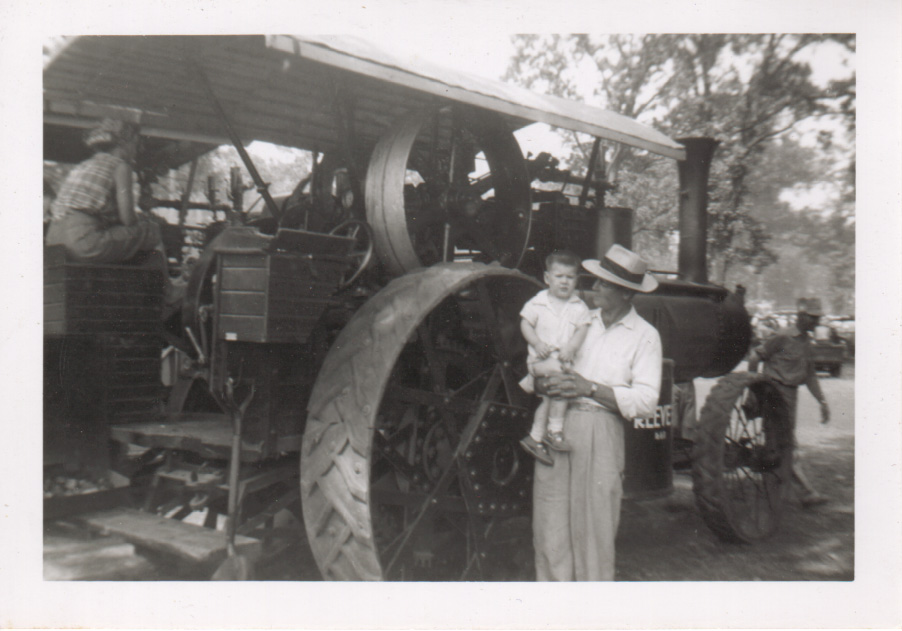
Joseph C. Rhode (1918–1999) with Son
Standing Beside Reeves Steam Engine
Owned by Lindenmier Family
At Central States Threshermen’s Reunion
Pontiac, Illinois, 1953

Even though a boy my age was selling hotdogs, we ate our own dinner (as farmers called the noon meal) when all the engines blew their whistles. I had to hold my hands over my ears because I could feel my eardrums imploding from the sound of so many whistles shrieking at close range. Little did I know that the hotdog boy was John Spalding, with whom I would one day write the nonfiction best seller titled The Steam Tractor Encyclopedia.

Back then, my mother served our dinner beside our car. We were not alone. Up and down the lines of vehicles were other families spreading their blankets and munching sandwiches in the shade of the mighty oak trees. We always ate tomato soup and cheese sandwiches. Not a fan of tomatoes, I looked forward to dessert. Mom made the best pies, cakes, and other baked yummies! It was not at all unusual for me to be presented a quarter of an apple pie that bubbled in the oven just the night before. My parents drank coffee; I drank milk. To this day, I can recall the fun of picnicking at Pontiac!

When we strode around the grounds to watch the steam engines, as well as the Rumely OilPulls, we had to glance over our shoulders to be sure no parading engine was sneaking up on us. At the age of four or five, I wandered behind a 16 HP Reeves engine that was parked and being fired by Doris Lindenmier. She and her husband, Lester, were engineers, and both exhibited Reeves engines. Doris turned around, saw me dawdling there, and asked me, “Do you like steam engines?” I was delighted that such a great person as a steam engineer would take notice of me. That day, she planted the so-called “steam bug” in me, although I was 40 before I could afford to buy a steam engine of my own. I took it to Pontiac, and Doris, still showing engines, invited me to follow her in the parade. As our engines proceeded, my tears of happiness were glistening in the sunshine.

To return to my elementary school days, I will mention that, at one of the shows, I admired the 50 HP Case, then recently restored by Sam Haley. Maybe Sam inspired me to purchase a 65 HP Case many years later. His sons, Jim and John, helped me during the steep uphill learning curve of operating a ten-ton steamer. Eventually, they built new bunkers for my engine.

When I was a kid at the Pontiac shows, legends were forming. Some of them I knew then, some I came to know later, and some I never knew. The legendary engineers included such names as Dan Zehr, Milford Reese, Wilbur Collins, Homer Dixon, J. D. Roberts, Art Erickson, Sylvester Fosdick, Ray Ernst, Herb Beckemyer, Russell Helm, and Henry “Father Time” Lucksinger. I could name many more, and I apologize for not naming them all. The Central States Threshermen’s organization was too big for me to name everyone here.

Typically, on the way to Pontiac or on the return trip, Dad changed a flat tire. In those days, flat tires on trips were expected, even customary. One year, Dad’s spare tire also gave out, and a long delay occurred while Dad searched through a town for a mechanic who could patch tires.

In certain years, Dad bought a model for me in the flea market. I still have my Lesney Models of Yesteryear Allchin traction engine, made in England, which I was given at the 1961 Pontiac show and my American 4-4-0 locomotive, which Dad purchased for me at the 1962 reunion—both in their original boxes. I also have a 1904 Spyker automobile in its box that Dad gave me when we attended the Pioneer Engineers Club show in Rushville, Indiana, in 1963.

The trips to engine shows were highlights of my younger years. I get what Pontiac citizen Bert W. Johnson meant when he said in 1968 that the excitement felt at threshing reunions was like “steam bubbling in your veins.”     

Saturday, October 7, 2017

Spare Moments at My Folks' Farm 4


When I was in fifth grade, my father suggested that we visit the Nesbitt Farm in Benton County, Indiana, to consider buying a purebred Polled Hereford. (The word polled means that the cattle are born without horns.) The idea was for me to show the cow at the county fair and to start a line of pedigreed Herefords to help pay for my eventual college education.

Vicky, a Polled Hereford from Nesbitt Farm

I remember Mr. Nesbitt as having a pleasant smile and standing tall. If you wanted to produce a child’s coloring book featuring life on the farm, your farmer would look like Mr. Nesbitt. He guided us to a pasture where we could see the heifers. Immediately, one caught my eye. She had a happy expression, almost as if she shared Mr. Nesbitt’s jovial smile. I asked my father if we could buy her, and Dad consented. Mr. Nesbitt invited us into his kitchen to sign the paperwork.

Me with My Nesbitt Farm Clarinet
Pine Village High School Marching Band
Pine Village, Indiana, 1971

On a table was a clarinet in a tan case. I stared at it as if mesmerized. For some time, I had wanted to learn to play the clarinet.

“Say,” Mr. Nesbitt said, reading my mind, “you wouldn’t know of anybody in the market for a clarinet, would you? My daughter wants to sell hers.”

I thought it was too much to be gaining a lovely heifer, already a pet in my mind, and a clarinet—all in the same day. So I said nothing. Dad understood how much I wanted a clarinet, and one look at my not-daring-to-hope face told him all he needed to know.

“I guess we could consider the clarinet, too,” said my father. “How much do you want for it?”

“Fifty dollars,” replied Mr. Nesbitt.

All the way home, I carried the clarinet in my lap. My heart was racing. I could hardly believe my good fortune. I needed no further proof that I had the greatest dad in the world!

Learning to play the instrument, though, was a struggle. My parents took me to lessons at a music store in Lafayette. For the first several weeks, my teacher, a young man named Mr. Baker, kept trying to help me make a note on it. All that happened was that my breath escaped around the mouthpiece until I had puffed so much that I could puff no more. One glorious afternoon, the clarinet emitted an enormous squawk! What a thrill! Mr. Baker breathed a sigh of relief while I smiled from ear to ear.

Me in the Indiana University Marching Hundred in 1975

From that day forward, my abilities rapidly progressed. That summer, I learned that Mr. Davis, the band director in my hometown of Pine Village, was adding younger musicians to the high school band so as to make it as large as possible for the band competition at the State Fair. He accepted me into the ranks. All summer, the augmented band rehearsed on the school playground. The competition consisted of parade shows, not football field shows. From the moment when the front rank of the band crossed the starting line until the back rank stepped over the finish line, a stop watch counted the seconds. Going overtime would cost precious points. Mr. Davis had built an observation platform accessible by a ladder. From the platform, he looked down on the band to see if the lines were straight. Over the weeks of practice, the band pounded the grass into powder. The white stripes that were formed with lime disappeared into the dust.

Ray Cramer
Director of the Indiana University Marching Hundred
Photograph by Larry Crewell
Bloomington Daily Herald–Telephone, 1975

My memories of the trip to Indianapolis include gagging on the girls’ hairspray on the bus, making sure that the decorative cords around the shoulder of my uniform were in the right place, and waiting in a line of bands that stretched as far as the eye could see. In those years, over a hundred bands of smaller schools competed on the day that the Pine Village band took part. Our organization came out somewhere in the top third. I can still recall part of the melodies and part of the steps.

Me on the Undergraduate Staff
Of the Indiana University Marching Hundred
Rehearsing New Members During Band Camp
In the Old Stadium on the IU Campus, 1975
 
I named my Hereford Vicky. She lived for the rest of her long life on our farm and produced many calves, all of them as sweet-tempered as she was. They helped me meet the cost of tuition at Indiana University, where I became a fixture. I earned my bachelor’s degree, my master’s, and my doctorate at IU. For the first four years, I performed on the clarinet with the famed Marching Hundred, with the pep band during the marvelous basketball seasons when Bobby Knight was the head coach, and with the summer concert band with music performed beside the iconic Showalter Fountain. I shared the title of Outstanding Bandsman with Fred Kelly, the drum major. For the next five years (while I completed my MA and my PhD), I served on the graduate staff of the Marching Hundred and continued to play clarinet in the pep band.

So the trip to Nesbitt Farm truly shaped my future.